Tuesday, November 17, 2026 · UX & UI Design
Google UX Designer Yi Xiang on Cultural Context and a Portfolio Built for Experiment
Noted by Tom May · 762 reads
Google UX designer Yi Xiang shares what moving across cultures taught him about collaboration, internationalisation and making his portfolio a creative lab.

For Yi Xiang, working across cultures has made design less about adopting a new identity and more about learning how people think, communicate and use products in different contexts. Now a senior UX designer at Google, he has studied and worked across China, Canada, Hong Kong and the United States. That path informs both his approach to collaboration and the experiments he shares through his portfolio.

Born in Jiangsu, China, Xiang studied interactive arts and technology at Simon Fraser University in Canada, then earned a master’s degree in interaction design at The Hong Kong Polytechnic University. His professional career began in mainland China, including a role at R/GA in Shanghai. He later joined TikTok as a product designer working on TikTok.com. In late 2025, he moved to the San Francisco Bay Area to work in Silicon Valley.
The move brought a new working culture and an unfamiliar job market. Xiang’s response has been to build knowledge through practice: finding designers with local experience, asking for candid feedback and using what he learns to identify where he can improve. His work has received recognition from the iF Design Award and A’ Design Award, but he describes confidence less as a matter of credentials than as a result of making, learning and listening.
Belonging through contribution
Moving to a new place can create pressure to adapt quickly, including pressure to fit a familiar picture of what a local designer should be. Xiang takes a more personal view. “People build a relationship with a place in different ways,” he says. “Keeping your own background and habits doesn’t prevent you from contributing.”
That distinction matters for teams working across borders. A designer can bring experience from elsewhere without treating it as a complete answer to local needs. Xiang was drawn to Silicon Valley by the number of people working where design meets technology. He wanted to see how they approach their work and to challenge his own habits. Conversations with local designers give him a way to test his understanding against the realities of the teams around him.
“It’s not about assuming I belong,” he explains, “but about continuously learning and pushing myself to become a designer who can contribute at that level.” His confidence, he says, comes from learning, feedback and making things rather than simply reassuring himself that everything will work out.
That approach also makes feedback practical. Instead of treating a different culture as a single puzzle to solve, Xiang can ask specific questions about how a team works, how an idea is received and what would make his contribution clearer. The answers can then shape the next discussion or iteration. For designers entering unfamiliar teams, that cycle offers a useful way to stay open without setting aside the experience they already bring.
Design changes with language and context
Xiang has found that communication can be demanding even when a designer understands the words being used. “Being able to express an idea is one thing; helping people from different backgrounds understand it and contribute to the discussion is another,” he says. The work is not just to present a point of view, but to make space for other people to engage with it.
He resists broad claims about “Chinese design” and “American design.” Differences, in his experience, depend on more than location: a designer’s career stage, a particular team and the product being made all affect how work happens. The principles of good design, he says, remain broadly shared, while the details need to respond to their context.
Language gives those details a visible form in an interface. Chinese can convey meaning with relatively few characters, but individual characters can be visually dense. That affects decisions about type size, weight, line spacing and hierarchy. A layout that feels balanced in one language may need different proportions when translated, even if the underlying structure and content priorities remain the same.
Other writing systems pose their own design questions. Longer words and labels can change the space a component needs; right-to-left text, including Arabic, affects reading direction and layout. For product teams, internationalisation therefore reaches into hierarchy, alignment and component behaviour, not just translated copy. Xiang describes the goal as “maintaining coherence, while making room for those differences.”
He has also observed that some Chinese digital products place emphasis on speed and a broad range of functions, while some Western products give more attention to motion and small interactions. He treats these as tendencies he has encountered, rather than rules that define either region. What interests him is how a carefully chosen detail can make an efficient product feel more human without interrupting the task someone came to complete.
A portfolio that keeps moving
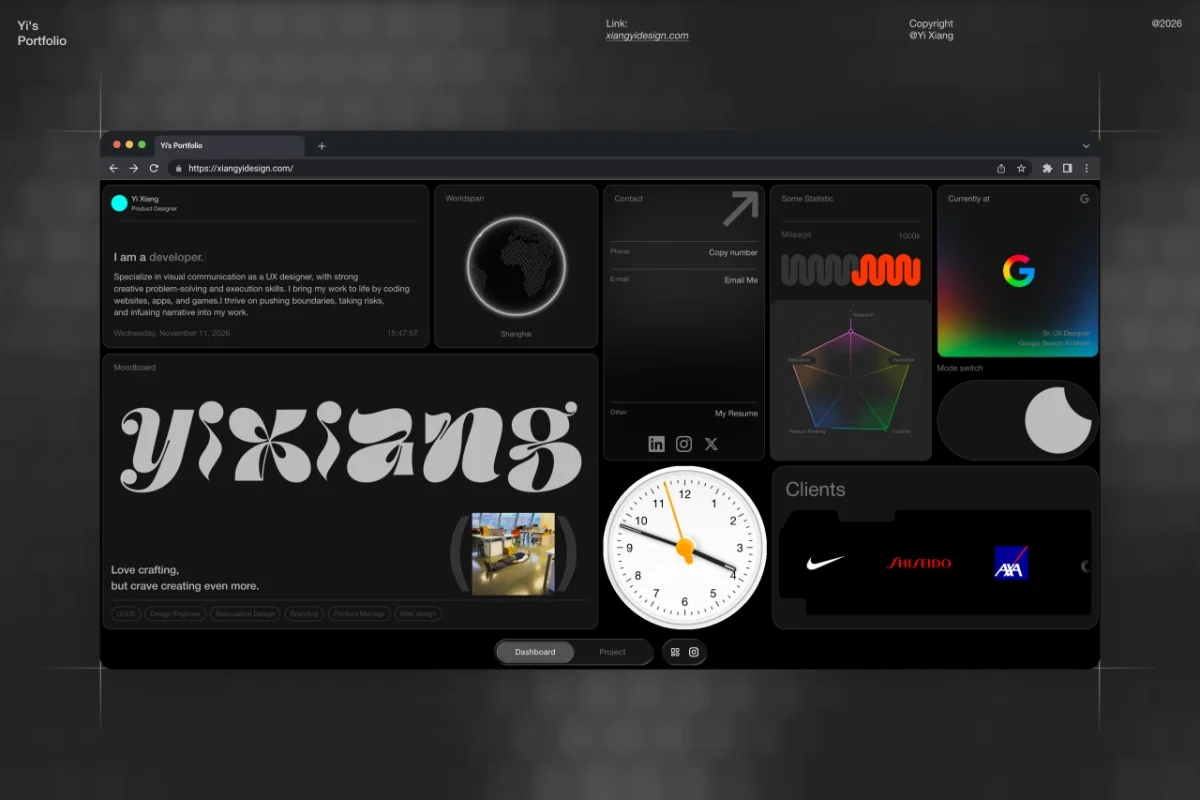
Xiang’s portfolio is less a fixed catalogue of finished projects than a place to develop ideas. He uses it as a laboratory for creative coding, with AI-assisted coding helping him build concepts that had stayed in his head for years. That work sits alongside his professional practice as a hobby and a way to explore what he might make next.
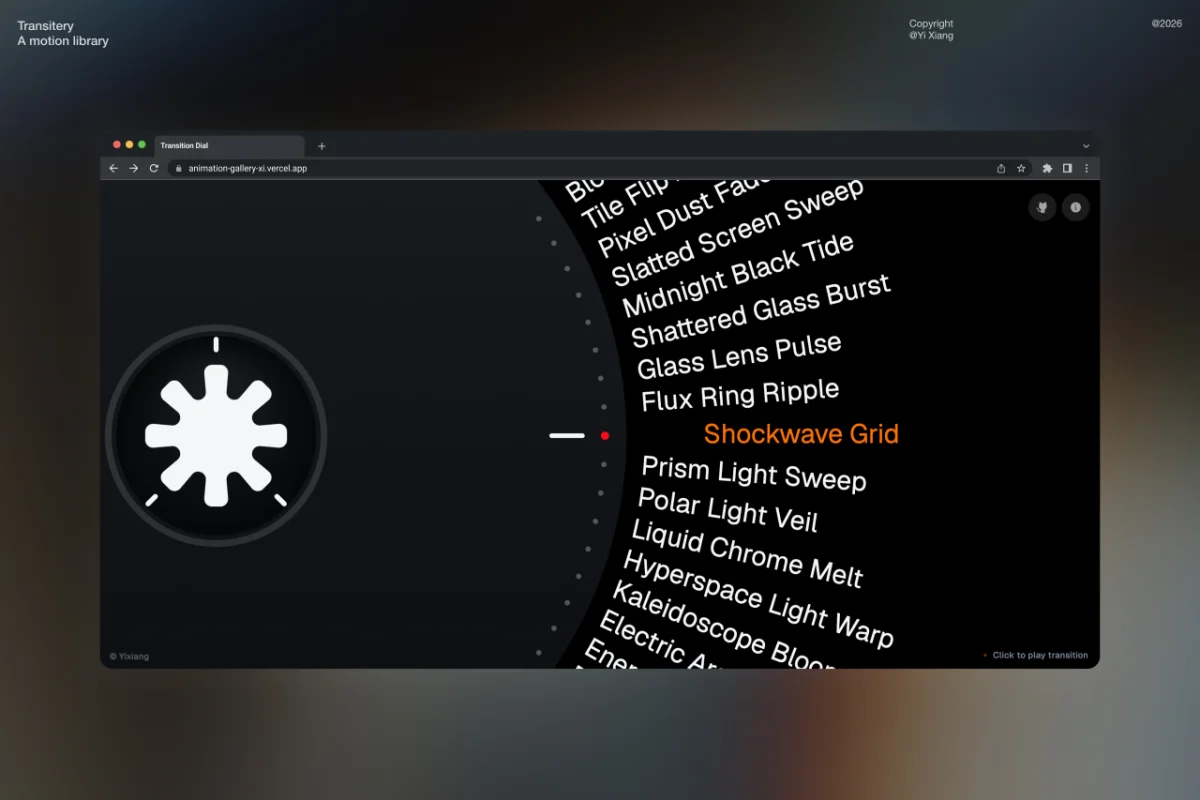
Two projects show the range of those explorations. Transitery is an open-source collection of transition animations. Vibe Text takes typed words and renders them in materials such as wood and jelly. Both turn an idea into something people can see and interact with, giving Xiang a space to test motion, texture and code outside the constraints of a single product brief.
AI can help shorten the distance between a concept and a working prototype, but Xiang draws a clear line between generating and designing. “Generating something is only a starting point,” he says. The output still needs a designer’s judgement: deciding what communicates the idea, refining the behaviour and shaping the result into a coherent experience.
Across his work and his portfolio, the through line is adaptation through making. Cultural context changes how a design communicates; feedback helps a designer understand those changes; experiments provide a place to try new forms. Xiang’s practical lesson for designers working across borders is to treat difference as material for decisions—about language, layout and collaboration—then keep testing whether those decisions help people take part.