Wednesday, November 4, 2026 · Graphic Design
Proterra’s Bus Failure Shows Why Strong Technology Needs a Scalable Business
Noted by Dr. Derrick Daye · 905 reads
Proterra’s buses worked, but custom builds and thin margins sank the business. Its story shows why technical performance must connect to repeatable customer value.
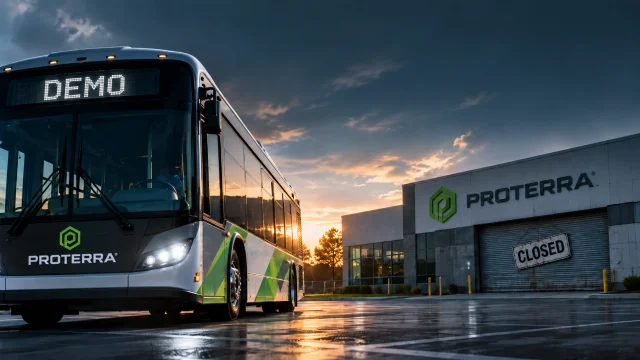
Proterra’s buses proved the technology could work. The company still couldn’t make the bus business pay. That gap is the central lesson for engineering-led firms: a strong product can win attention, early customers and contracts without building a company that can deliver profitably at scale.
In 2022, Proterra had delivered more than 1,000 electric buses and held contracts with 135 transit agencies. Revenue rose 24% to $309 million as the U.S. electric bus market grew 66%. Yet in August 2023, the company filed for Chapter 11. Its commercial problem had been accumulating for years: contracts were signed 12 to 18 months before production, and deals made in 2021 were priced below the buses’ eventual 2022 manufacturing costs. Each transit agency wanted a different configuration, while competitive bids pushed prices lower. In five of the six quarters before the filing, Proterra sold buses for less than they cost to build.
The outcome of the sale process makes the distinction plain. Twenty-six prospective buyers passed on the bus business, while Volvo bought Proterra’s battery technology. The Proterra name now remains on a battery business run with Volvo. The technology found a home; the company built around the buses did not.
That split is a useful test for any company whose product seems years ahead of its market. Can the business make the product repeatable, dependable and economically sustainable? A compelling demonstration answers whether a technology can perform. It doesn’t answer whether customers will keep choosing the supplier, whether operations can support demand or whether each sale can produce a healthy margin.
Performance earns a hearing; the whole offer earns the order
Engineering teams often describe an advantage through measurable performance: faster processing, greater precision, lower energy use or more autonomous operation. Those qualities matter, but buyers make decisions against a broader set of concerns. They consider whether a product fits existing systems, how reliably it will operate, what implementation demands from their teams and whether the supplier can support it over time.
For transit agencies, a bus has to fit into fleets, depots and purchasing processes. Proterra’s effort to meet each buyer’s particular requirements made its offer harder to repeat. The customer’s request may have been reasonable in isolation; the business accumulated the cost of treating each contract as a new configuration.
This is why brand strategy can affect the economics of choice. It connects a company’s capabilities to the outcomes buyers care about, and explains why that company is a credible option. A product feature can make a supplier worth evaluating. The wider offer—fit, evidence, delivery and continued support—helps make it worth selecting.
That case also has to work for more than one audience. Technical evaluators need proof that the product performs. Operational leaders need to understand how it will work in practice. Procurement teams look for a supplier that can meet delivery and contract requirements. Investors want to see how customer demand can become a durable business. These groups may share an interest in the technology, but they’re accountable for different outcomes.
A single technical pitch rarely addresses all of them. A clear strategic position gives the company one consistent reason to matter, then connects that reason to the evidence each audience needs. Positioning is a leadership decision: it shapes which problems the company chooses to solve and how its teams explain the value of that work.
The hard step comes after early production
Prototypes and initial sales can make a company look as if the market has accepted its product. A more demanding transition follows: turning early purchases into continued adoption, stable operations and repeatable revenue. A 2026 analysis from the Center for a New American Security describes this as a second valley of death for defense technology: the move from initial production and purchases to sustained institutional funding.
The underlying challenge reaches well beyond that field. A product can attract investment, perform in testing and win early contracts without becoming a standard part of how customers work. Long-term adoption depends on budgets, operational requirements, production capacity and organizational commitment. Branding can’t supply those things. It can help leadership clarify whether the company has a credible, lasting role in the customer’s plans.
There’s a meaningful difference between being known as an interesting supplier and being understood as a necessary enterprise partner. The latter requires more than a list of product capabilities. Leaders need to define the customer problem the company can address, the contribution it can sustain and the evidence behind its claim. A clear position can support the economics of growth by making the company’s role easier to recognize and buy.
Five shifts that turn product strength into business strength
- Explain consequences, not just capabilities. Spell out what the technology enables and how that changes customer economics, risk or performance. A specification list describes the product; it doesn’t yet explain why the business matters.
- Start with the problem, then define the offer. A product category helps buyers compare alternatives, while a costly problem gives them a reason to act. But responding to every variation in demand can make the offer impossible to scale. Proterra’s custom bus configurations show the cost of adapting contract by contract without establishing a repeatable product. As growth can become a brand liability, focus matters as much as reach.
- Make the strategy usable across the organization. A founder may be able to explain why the company wins, but growth requires engineering, product, operations, sales and customer teams to make consistent decisions from that understanding. If the rationale lives only with the founder, it can’t guide the company at scale.
- Support claims with evidence beyond a demonstration. Buyers need to assess reliability, delivery, customer outcomes and operational discipline alongside performance. A demo establishes that a product can work in a particular setting. It doesn’t, by itself, show that a supplier can deliver repeatedly.
- Build preference beyond the contract. Winning a deal is a beginning. Lasting advantage means continuing to be a trusted choice as customer needs and competing products change. If every renewal has to be won from the beginning, the relationship may not have become a durable preference.
Together, these shifts move a company from technical distinction toward a more defensible market position. They also help explain why strong products can fail without market engineering: the business has to shape an offer customers can adopt and the organization can deliver.
When the company changes faster than its story
Proterra’s technology outpaced its business model. The reverse gap can also hold a company back: its capabilities and role evolve, but customers continue to understand it through an old description.
The Blake Project worked with Southern California technology company UP.Labs as it became Vantora. UP.Labs began with a venture-building model and major enterprise relationships, including Porsche, Alaska Airlines and J.B. Hunt. As its work developed, “venture builder” no longer explained what the company did.
Vantora had become a purpose-built company builder, creating AI-native companies and capabilities around difficult enterprise problems and turning them into lasting assets for corporate partners. Those roles lead to different conversations. A venture builder may be judged as an experiment in innovation; a company builder solving enterprise problems may be considered as part of a customer’s wider strategy.
Closing that gap called for more than a new name. The company had to clarify the business it had become and the role it could credibly play. As rebranding when a business outgrows its brand illustrates, the problem may be market understanding rather than a shortage of capability.
That distinction is worth tracking inside any scaling company. New products, customer relationships and strengths can change what the business is equipped to do. If the market still sees the earlier version, the company may miss opportunities that fit its actual abilities. Vantora addressed the gap between its business and its story; Proterra never resolved the gap between its technology and its economics.
Signals that the market is falling behind
The mismatch between technical achievement and commercial strength often appears through recurring friction. Leadership should look for patterns such as these:
- Technical evaluations go well, but purchasing stalls. Product experts see the value; decision-makers still lack the evidence or confidence to proceed.
- Sales cycles keep stretching. Teams must repeatedly explain what the company does and why it matters, rather than building on a shared understanding.
- Every customer asks for a different product. Custom work may help close an individual deal while weakening repeatability and margins. Proterra shows how that pattern can accumulate.
- Teams describe the company in conflicting ways. If engineering, sales and leadership tell different stories, the problem may sit in the strategy itself. Clarity is a strategy problem as much as a communications one.
- Customers praise the product but don’t expand their use. Successful pilots and renewals don’t automatically become strategic relationships. It’s useful to ask whether customers are choosing the company or simply staying with it.
- Investors, recruits or partners describe the company differently from its leaders. When a company’s account of itself doesn’t travel, the market fills in its own explanation.
- The business has changed, but its position hasn’t. New capabilities may have outgrown the original story, as UP.Labs did before becoming Vantora.
These signals don’t prove that a product is failing. They suggest the market’s understanding may be lagging behind the business. Addressing that gap before a major launch, funding round or purchasing cycle gives leaders room to clarify the offer while choices are still open.
Questions that test the business behind the technology
Investors and leaders can examine whether the company is building a distinctive enterprise or assembling impressive products without a repeatable route to market. Five questions help:
- Can leadership describe the customer’s problem without naming its technology? If not, the solution may be clearer than the demand it serves.
- Does each buying group have a reason to say yes? Engineers, operators, procurement and finance need evidence tied to the results they own.
- What supports the case beyond product performance? Look for delivery history, reliability, customer outcomes and the ability to keep products working over time.
- Can the offer be repeated? If every contract calls for a different product, growth can consume capital faster than it creates margin. Proterra is a warning about that tradeoff.
- Would customers notice if the company disappeared? Their answer can reveal whether the supplier has become a preferred partner or remains easy to replace.
Brand strategy can help leaders organize the business around a distinct, credible promise, but it can’t make weak economics work by itself. Its value is practical when it helps the company choose where to compete, align teams and show why customers should keep choosing it. That makes brand a way to address business problems, not simply a marketing expense.
Proterra’s batteries found a buyer. Its bus business did not. For companies building in AI, energy, aerospace and advanced manufacturing, the enduring work is to connect technical advantage with customer relevance, operational confidence, a repeatable offer and sustained economic return. The next demo may prove the product works. The business has to prove it can keep working for customers.
Dr. Derrick Daye is Managing Partner of The Blake Project and Publisher of Branding Strategy Insider.
The Blake Project helps leaders use brand to strengthen pricing power, competitive position and enterprise value through its Value Acceleration Studio. Contact the team to discuss profitable growth.