Friday, October 9, 2026 · Graphic Design
LAFC’s Sponsorship Deck System Turns More Sales Conversations Into Shareable Proposals
Noted by Kalyn Lewis · 778 reads
LAFC’s approved slide library helped its partnerships team create 42% more content in 12 months, making personalized decks practical for more conversations.
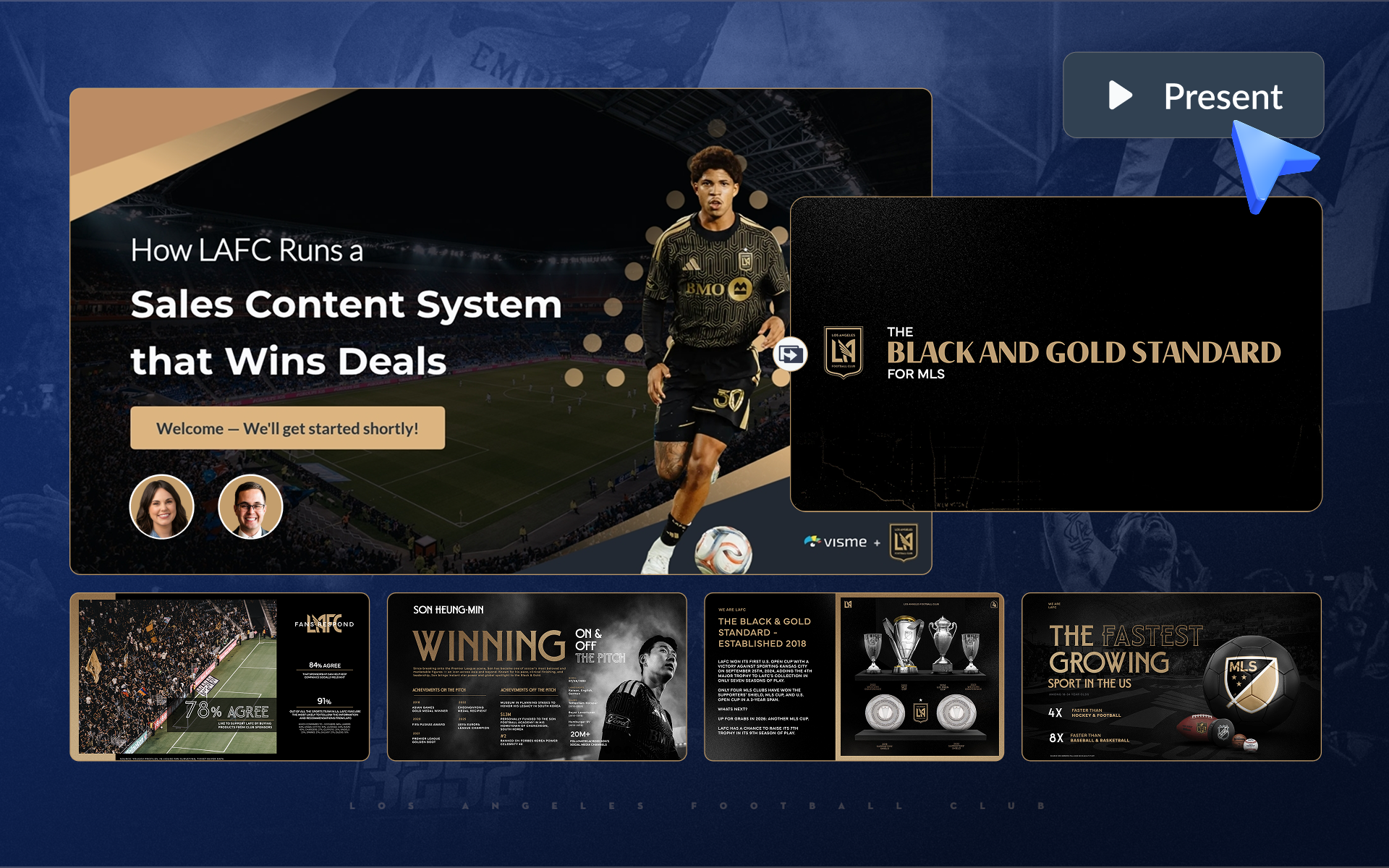
LAFC’s approach to sponsorship pitches treats the deck as part of the conversation’s ability to travel. A representative may have a strong meeting with a brand, but the person they speak with often needs to explain the proposal to colleagues who weren’t there. An approved library of reusable slides helps the team give that internal discussion a visual, tailored starting point.
Alex Zani, from LAFC’s Corporate Partnership Strategy department, described the change during a webinar: his team removed the need for representatives to decide whether a conversation warranted a deck. The goal was to make personalized material practical for every conversation. Over twelve months, the partnerships team produced 42% more content through its Visme account, without adding hires or hours.
A pitch has to work after the meeting
The case for a deck becomes clearer once the representative leaves the room. LAFC’s contacts may need to take a proposal to a procurement lead, a CFO or other decision-makers. Without a visual document, they must relay the meeting from memory, notes or an AI note-taker. The people weighing the opportunity see no tailored picture of what the partnership might look like.
A personalized deck gives the contact something concrete to share. It can preserve the proposal’s context and help colleagues understand the fit without relying on a second conversation with the representative. That matters in sponsorship sales, where the person who first expresses interest may not control the final decision.
The same challenge appears in other business-to-business sales. The source cites a Gartner survey of 646 buyers, 67% of whom said they prefer a rep-free experience. For sales teams, that points to a practical role for content: it must explain and support a proposal when no salesperson is present.
That doesn’t mean every conversation will become a deal. Some meetings are exploratory; some brands are unlikely to proceed; and requiring a deck after every call can add work if the production process stays cumbersome. LAFC’s response was to change that process, rather than simply tell representatives to make more presentations.
Why the skipped deck is hard to track
Representatives routinely decide whether to prepare follow-up material based on their own judgment and circumstances. They may be short on time, see an opportunity as too early, or expect the conversation alone to carry the proposal forward. Sales systems can track stages, relationships and other qualification signals, but the choice to make or skip a personalized deck often has no field or dashboard of its own.
That makes the effect difficult to identify later. If an opportunity stalls months after an initial conversation, a review may focus on price, timing or fit. The team may not connect the result to the absence of material that the buyer could have circulated internally.
Availability can also shape who gets a deck. A team’s workload, the point in the season and the number of active pitches can all affect what gets produced. Two brands with similar size and fit may therefore receive different follow-up simply because one arrived during a busier period.
The missing document doesn’t prove why a deal stalled. But it can leave the original contact with more work: they have to reconstruct the meeting, explain the proposal and answer questions from people who weren’t present. A tailored presentation gives that internal conversation a clearer reference point.
A library built for four audiences
LAFC’s system starts with four audience-specific decks. Representatives select relevant slides from a library that is kept current and approved, then personalize the material with dynamic fields already set up in the deck. They don’t begin with a blank slide or hunt through an old presentation to find something built for a vaguely similar brand.
The distinction is operational as much as visual. A generic template with a logo swapped in may be quick to produce, but it doesn’t show that the team has considered a brand’s goals or how a partnership could serve them. Audience-specific starting points and editable fields give representatives a way to tailor the proposal while relying on shared, approved source material.
The library also changed the review path. Previously, three people reviewed a deck: Zani checked the data, the design team checked the visuals, and the head of partnerships checked the work against brand standards. With representatives building from approved slides, the head of partnerships is now the only reviewer. The reasoning is straightforward: if the content and design have already been checked in the library, repeating those checks for each assembled deck adds another step without addressing a new issue.
For teams considering a similar setup, the useful sequence is visible in LAFC’s process: organize material around distinct audiences, keep the library current, approve the data and visual system in advance, and make the points that change from one brand to another easy to edit. That structure can reduce repeated review while still giving representatives room to make each proposal relevant.
More content because fewer decks get skipped
LAFC’s 42% increase in content production over twelve months is easy to interpret as a speed improvement. Zani clarified that a deck still takes about as long to build as before. The change was that presentations which once might not have been made now got produced.
That’s a different view of productivity: the system increased the amount of useful work completed by lowering the friction around starting and reviewing it. Representatives didn’t need to weigh the same deck-or-no-deck question each time, and the team could move through a shorter approval path.
“The time saving is just having more conversations, and more conversations will lead to more wins. That's been crucial for our team.” — Alex Zani, LAFC’s Corporate Partnership Strategy
Zani presents the system as work in progress, rather than a finished formula. That qualification matters: a slide library needs upkeep, and audience-specific decks only help when their content stays accurate and relevant. The recorded webinar with Zani and the LAFC case study offer more detail on the team’s work with Visme.
Designing the follow-up, not just the meeting
For sales leaders, LAFC’s example raises a useful process question: how often does a good conversation end without a shareable follow-up because producing one feels like extra work? A deck won’t guarantee a sale, but it can give the contact a clearer way to carry the proposal to colleagues.
The practical lesson is to make personalized content easy to assemble and straightforward to review. When the system supports the work, representatives can give more conversations a tailored next step—and the proposal has a better chance of remaining clear after the meeting ends.
Watch the recorded webinar with Alex Zani or read the LAFC case study for more on the team’s process. Visme also outlines its tools for creating personalized sales content.