Thursday, November 12, 2026 · UX & UI Design
A Holiday Film Bets That a Parent's Belief Can Restart a Creative Life
Noted by Mikelle Leow · 373 reads
Apple's holiday film The Dreamer follows a young artist who sets drawing aside until his parents' MacBook Neo helps him start again.
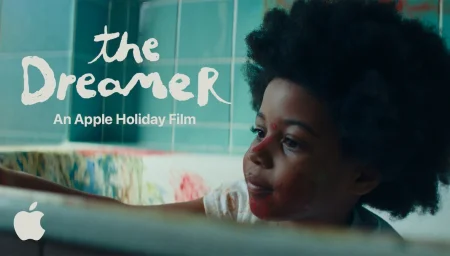
Apple's holiday film usually sells a machine, but The Dreamer leans harder on the people around the machine. Watch the film and you'll see a story about a young artist whose imagination dims as he grows older. What brings him back isn't a spec or a feature. It's his parents, who refuse to write off his creative streak. The laptop is there, but the belief does the heavy lifting.
Who made it and how the story is built
Created by TBWA\Media Arts Lab, the film is directed by Melina Matsoukas, with cinematography by Bradford Young. Hebru Brantley produced the original artwork. The film opens on a boy whose drawings give shape to a busy inner world. By young adulthood, he has set art aside and lost touch with the ideas that once came easily. Here's the thing: the film doesn't treat that drift as failure. It treats it as a pause that the right push could end.
The parents are the turning point. They give him his first MacBook Neo, and the gift works as a statement of faith as much as a product handoff. It becomes the first step back into drawing: a storyboard for a new character, made in Brantley's distinctive visual language.
The laptop as a sketchbook
The film sets its return-to-art arc to Strawberry Guy's Give Me a Dream, and the MacBook Neo sits inside that process rather than sitting on top of it. The character explores and develops his figure on the device until it comes alive on screen. That's a more interesting framing than the usual product shot.
Digital sketching is a workflow many illustrators already know. You rough out an idea in a loose layer, push it around, and keep momentum going without a blank page stopping you cold. The film is betting that the lowest-friction tool is the one that gets someone drawing again. Whether that holds for every creator is an open question, but the idea is clear, and the campaign shows it rather than explaining it.
Made by people who lived the premise
Matsoukas, Young, and Brantley drew on their own early years as aspiring artists, when encouragement from someone else mattered before their careers had any real shape. That's the emotional core. Creative work carries a lot of uncertainty, and a story built on people who've lived through that uncertainty tends to land with more weight than one built on research.
Matsoukas framed the project in terms of purpose: "My goal with work is to create pieces that move people and create change in the world. I saw the opportunity to do that with this project and was fortunate to work with a brand that had the courage to do so. In this moment in the world, to deliver a message that inspires people to follow their passions, to protect our artists, and to look at the world as a canvas of possibilities, is something I'm very proud to have been a part of."
Brantley's art carries the arc
Brantley made every artwork in the film, from the protagonist's childhood sketches to the character he creates after returning to drawing. The illustrations are built to track development. They grow in complexity as the story moves from childhood into adulthood, so the audience reads that growth before a line of dialogue explains it.
That's a useful technique for anyone building a visual narrative. Let the drawing style itself show time passing. Brantley finished the final character on the MacBook Neo, moving between physical drawing and digital creation throughout. That back-and-forth is how many working illustrators actually operate, and it's refreshing to see it shown plainly rather than staged as a single clean workflow.
Brantley explained the personal side of it: "Our experiences shape what we create. My mother saw the artist in me before I could see it in myself, and her belief gave me the confidence to explore that – which I'll continue to honor. That's why this story is special to me. The right tools can help us unlock our creativity. For the young artist in the film, the MacBook Neo is also a reminder that his parents see the potential in him, and an invitation to reconnect with it."
The companion film
A behind-the-scenes piece, Creating the Art, produced for @helloapple, goes deeper into Brantley's process, from early concepts to the finished work that appears on set. He talks about his mother and says she recognized his abilities before he understood them himself. "She saw it first and most," he says.
That support shaped how he thinks about making things at all. As Brantley puts it, "I could create, I could make something from nothing." For a viewer who works in design or illustration, that's the line worth holding onto. Creation often starts from a small, specific sense of possibility, and someone else's belief can be what makes it visible.
What to take from it
The Dreamer returns to a familiar Apple idea: the right tools matter, but so do the people willing to see potential early. For working designers, the more useful takeaway may be the process the film shows. Watch how the sketches change across the timeline, and notice how the device fits into a rough-to-finished workflow rather than replacing it.
Whether you're mentoring a junior designer or rethinking your own creative routine, the lesson holds. Creative work often restarts when someone tells you they can see it, and then you have to pick up a pencil, or a stylus, and begin again.