Friday, November 27, 2026 · Graphic Design
Brand Consistency in 2026: Why Templates Still Need Design Oversight
Noted by Orana Velarde · 948 reads
Survey data shows where brand work breaks down: scattered guidelines, manual template fixes and review queues that consume hours each week.
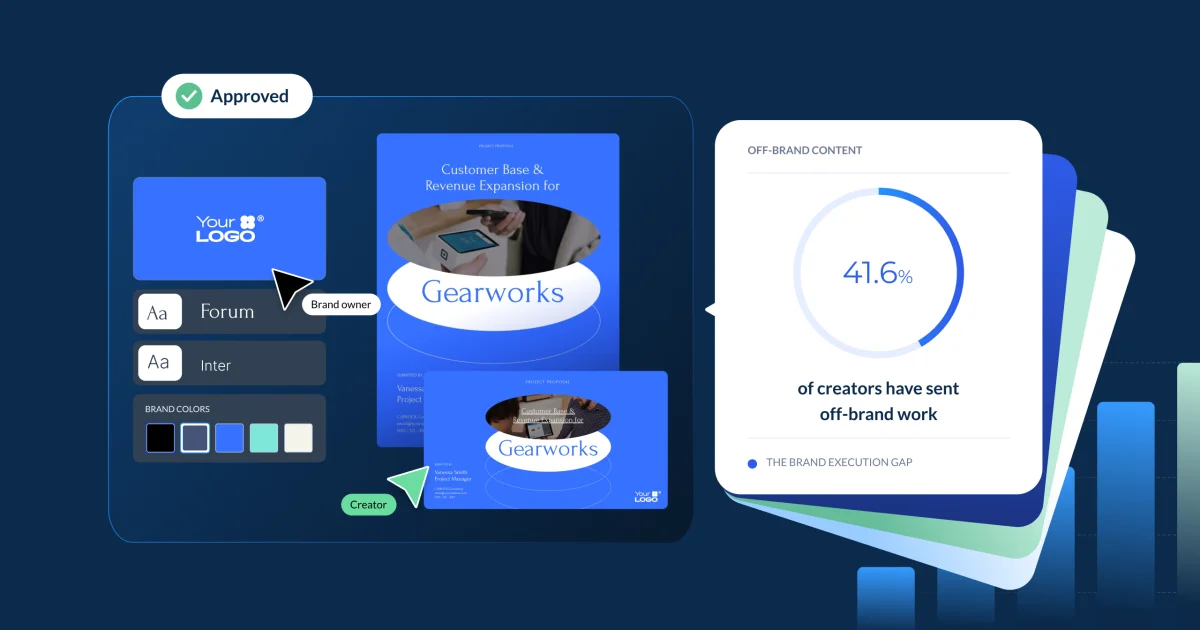
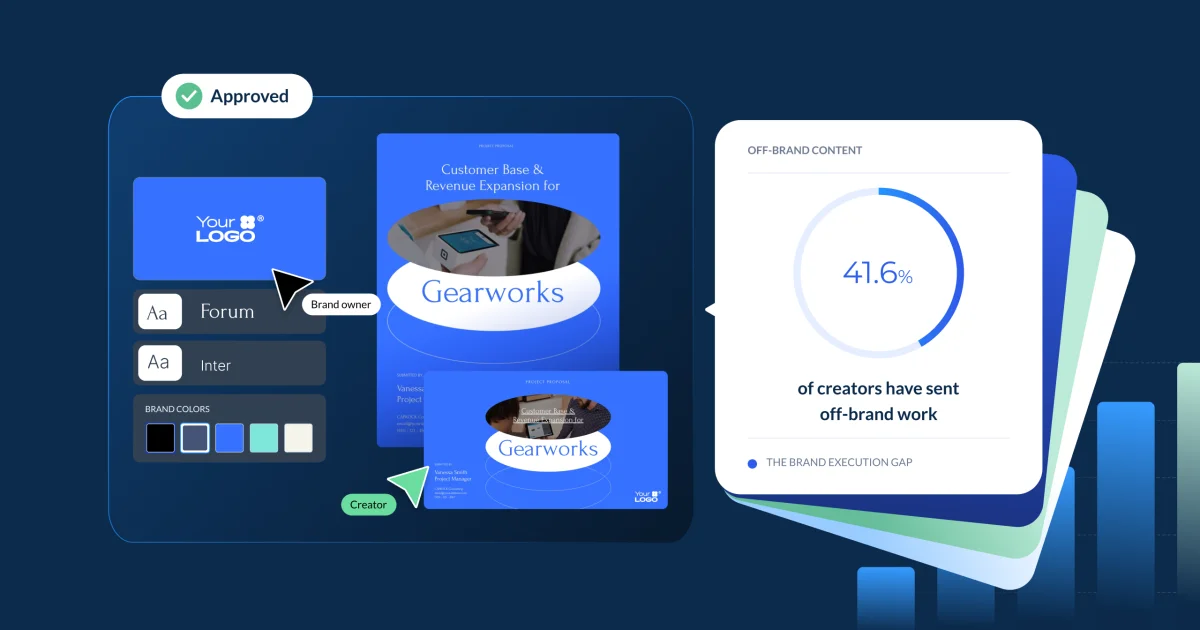
Brand rules are easy to document and harder to apply. A recent survey of brand owners and content creators found that 41.6% of creators had sent work out before discovering it was off-brand. Even people confident with the basics—logos, type and color—can struggle when a layout needs to change or a reference is hard to find.
That gap matters beyond visual polish. Research on advertising associates brand consistency with stronger brand effects and higher returns, while the everyday work of proposals, reports and presentations shows how easily consistency can slip. The practical issue is often less about whether guidelines exist than whether teams can use them at the moment they make a design decision.
The figures below bring together The Brand Execution Gap 2026, a survey of 304 brand owners and 303 content creators at mid-market companies in the US, UK, Canada and Australia, with studies from McKinsey, System1, Effie, Optimizely, Gartner and Forrester. The Visme surveys took place in May and June 2026; the other research spans 2025 and 2026.
Consistency has measurable value
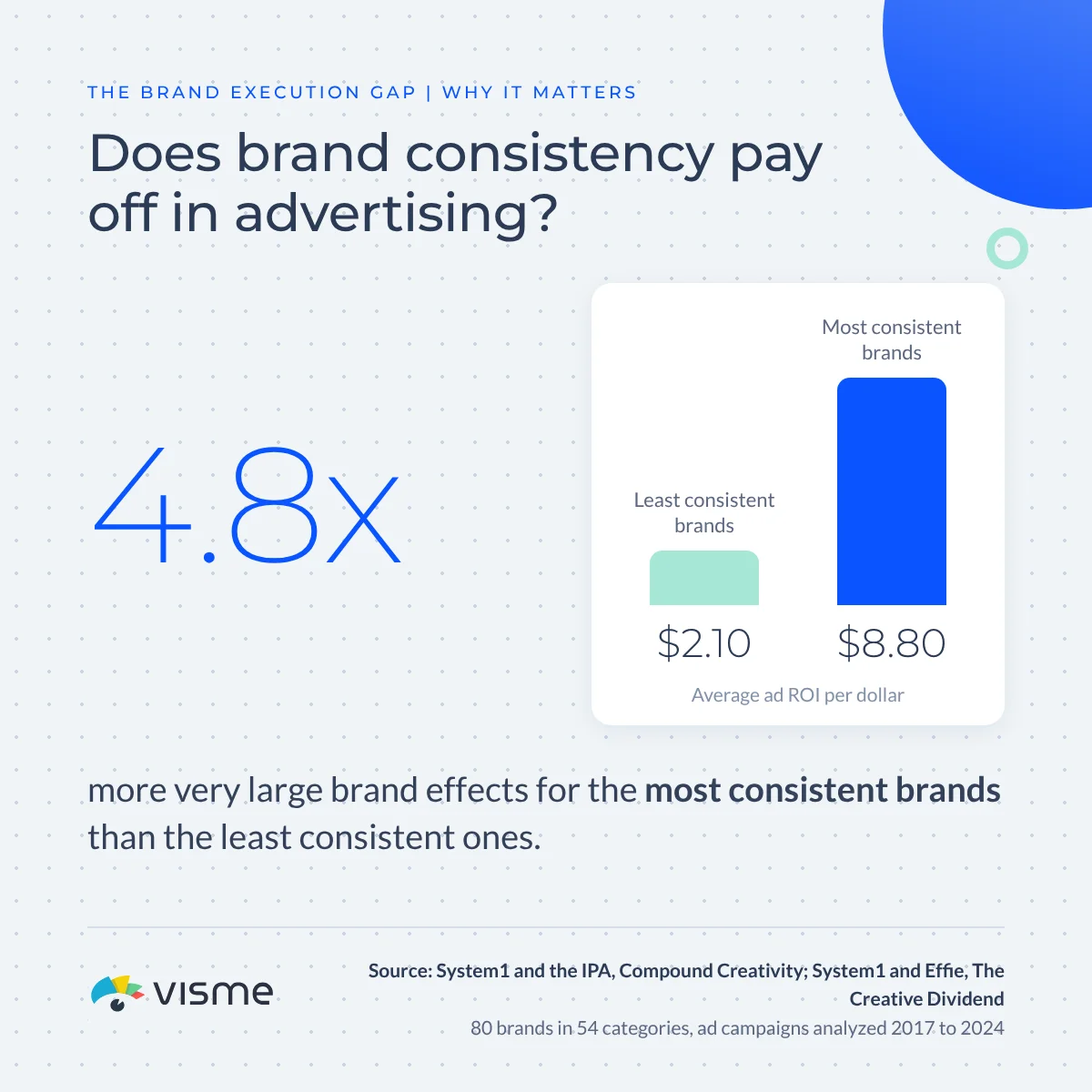
In McKinsey’s State of Marketing Europe 2026 survey, branding ranked as the top priority for 500 senior marketing leaders. Separate research connects consistency to advertising outcomes: System1 and the IPA analyzed 80 brands in 54 categories from 2017 to 2024 and found that brands in the most consistent quartile generated 4.8 times as many very large brand effects as those in the least consistent quartile. A companion study by System1 and Effie put average advertising return at $8.80 per dollar for the most consistent brands, compared with $2.10 for the least consistent.
Those results concern advertising. The daily mechanics are different when an employee adapts a sales deck, adds a chart to a report or makes a one-page document fit new information. That’s where the survey shows the gap between defining the brand and applying it across routine work.
Confidence holds up for specifications, then drops for judgment calls
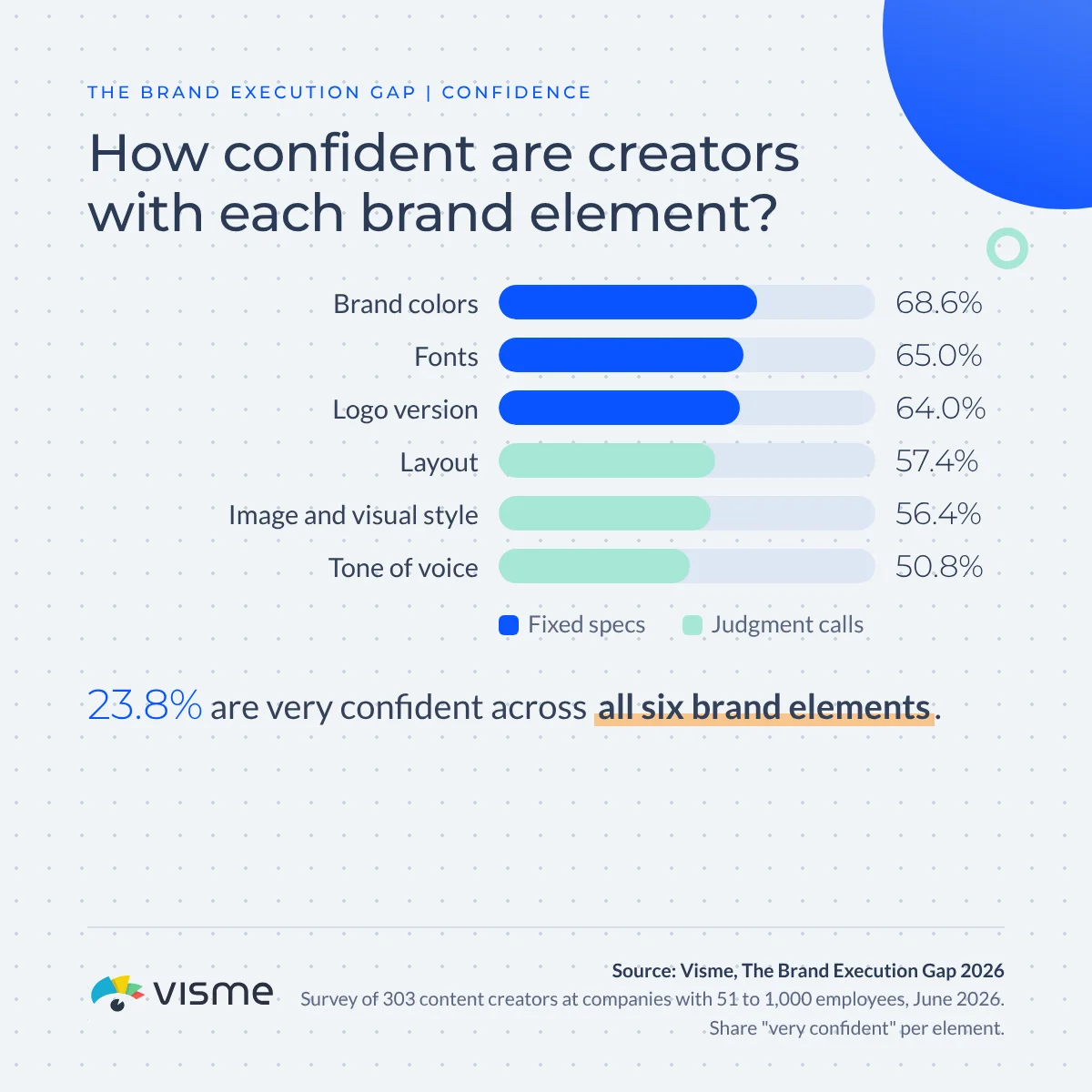
Creators reported the most confidence with elements that can be specified directly: 68.6% said they were very confident choosing brand colors, 65.0% using the correct fonts and 64.0% selecting the right logo version. Confidence fell for layout, at 57.4%; image and visual style, at 56.4%; and tone of voice, at 50.8%. Just 23.8% felt very confident across all six brand elements.
Confidence doesn’t eliminate mistakes. Overall, 41.6% of creators had sent work and later learned it was off-brand. Among those very confident across all six elements, 37.5% had done so, compared with 42.9% of other creators. Colleagues had corrected 29.2% of the highly confident group and 28.1% of everyone else.
Confidence does seem to help when a creator needs a precise specification. Among creators very confident in the brand, 29.9% had been unsure which logo to use, against 43.1% of those less confident. The same pattern appeared for missing font specifications—12.7% versus 40.6%—and guessing or searching for a color—16.8% versus 31.6%.
The harder cases tend to involve decisions with no single preset answer. A sales representative may know the logo and color palette but still have to resize a layout for a pricing table. A small adjustment can push a logo too close to an edge or disrupt the spacing. The result may look nearly right, while still feeling less considered beside a competitor’s work.
Applying the rules is the skill gap
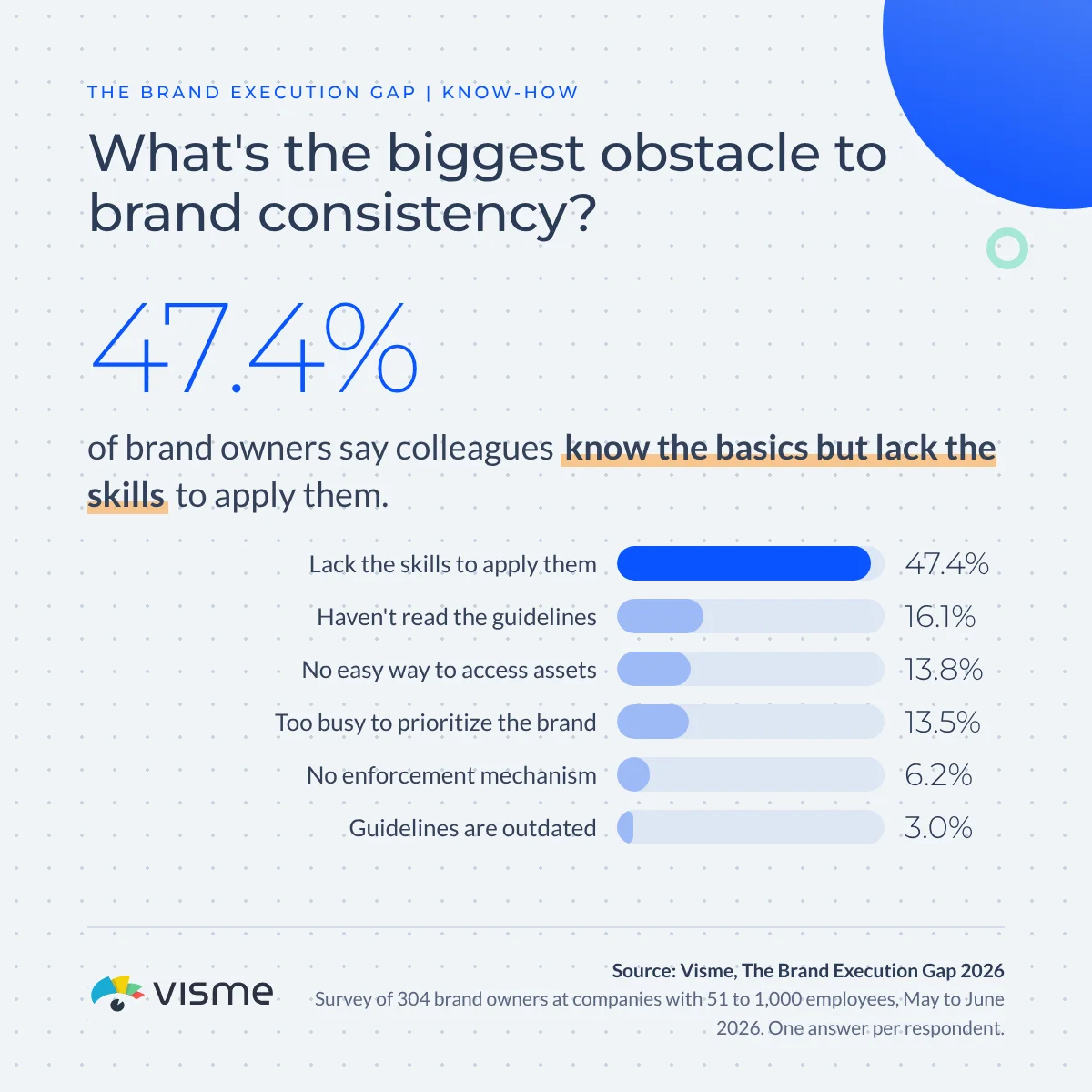
Brand owners most often named practical ability as the barrier: 47.4% said colleagues knew the basics but lacked the skills to apply them. Another 41.8% described colleagues who understood the basics but struggled with nuance. A further 24.7% said colleagues worked from a general impression of the brand and made regular mistakes. Together, those last two groups account for 66.4%.
By comparison, 16.1% said colleagues didn’t read the guidelines, while 13.8% pointed to difficulty finding the right assets or templates. Some colleagues do apply the rules confidently: 23.7% of brand owners described their coworkers that way. Yet even among those owners, 45.8% still cited missing skills as the biggest obstacle, and 65.3% spent at least three hours a week on brand work.
The mistakes owners see most often are layout and spacing errors, reported by 50.3%. Font mistakes came next at 49.3%, followed by color at 44.4% and logo use at 43.1%. This ranking suggests that instructions for fixed brand assets address only part of the work. People also need help adapting components while maintaining alignment, hierarchy and proportion.
Companies commonly respond with training and review: 64.8% of brand owners train colleagues in brand use, and 62.8% review other people’s work. Among creators, 67.3% said their work went through formal approval or designer review, while 23.4% received peer comments. A brand owner in the US described catching manual layout and spacing problems during review, even when colleagues already knew the basic colors and logos.
That points to a more useful training brief: help people make the small design decisions that arise when a chart grows, copy runs long or a short document becomes a full report. Repeating the rules may not resolve a problem that appears only when someone has to adapt a layout.
Creators look for answers, but the references are scattered
The survey suggests most creators care about getting the brand right: 97.4% described an approach where brand accuracy mattered. More than half, 53.5%, said they wanted work to look exactly right and would spend extra time. Another 32.7% aimed for “close enough,” 11.2% matched earlier work and 2.6% put the brand behind the content itself.
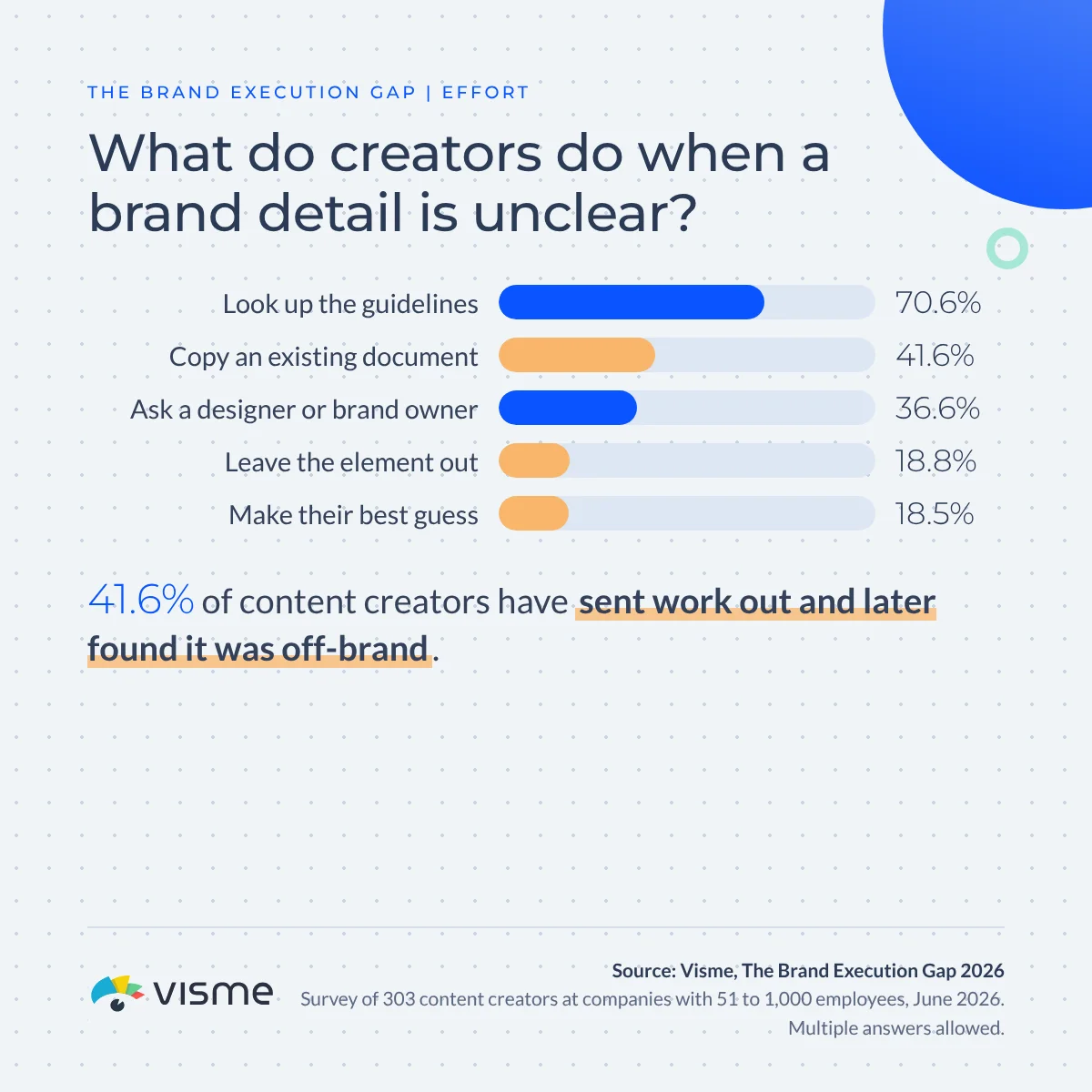
When a detail is unclear, 70.6% look up the guidelines. But 41.6% also copy an existing document, 36.6% ask a designer or brand owner, 18.8% leave the element out and 18.5% make their best guess. These responses can overlap: a creator might check a reference and still ask a colleague. They show several routes to an answer, rather than one dependable path.
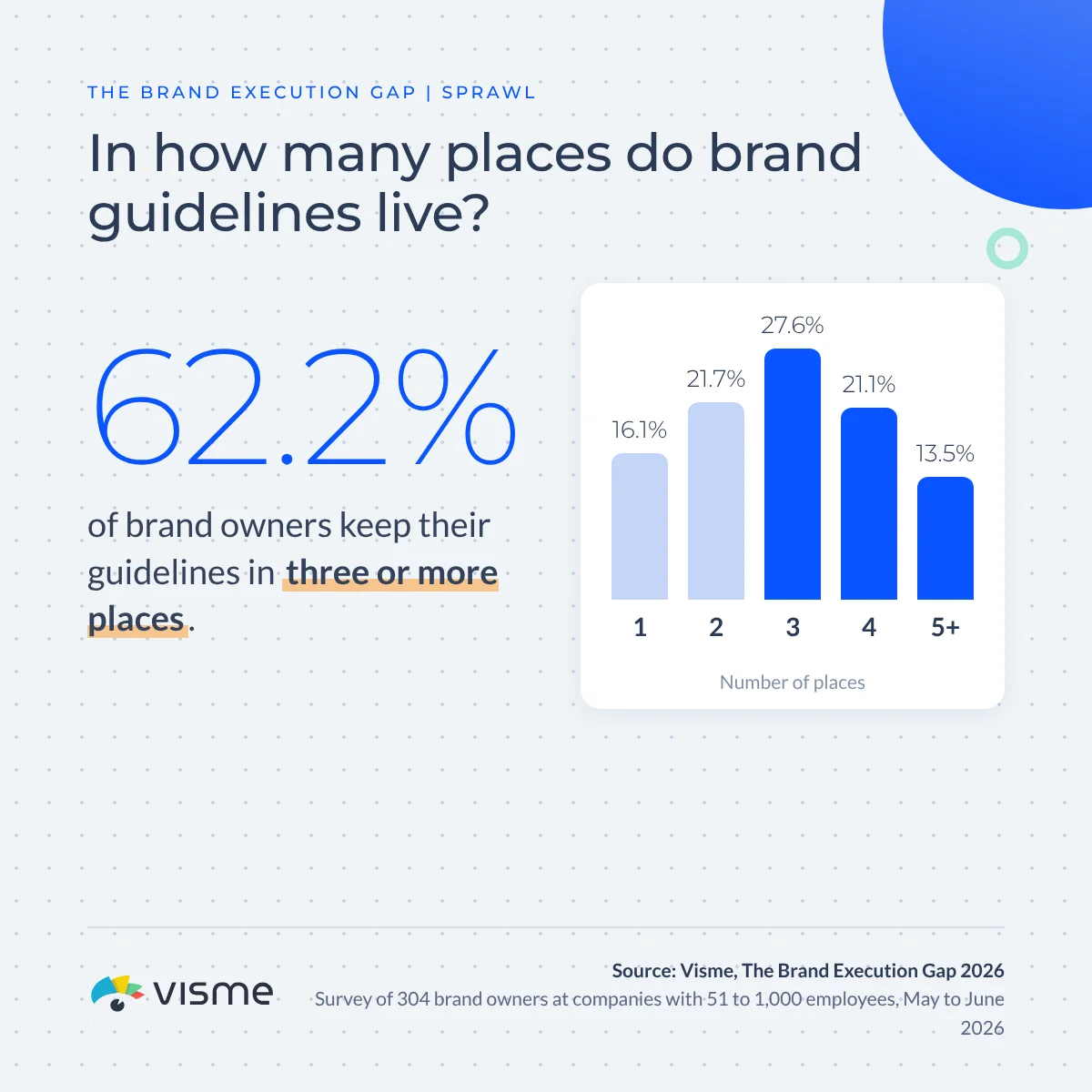
Guidelines often live in multiple locations. In fact, 62.2% of brand owners kept them in at least three places. The breakdown: 16.1% used one location, 21.7% two, 27.6% three, 21.1% four and 13.5% five or more. Brand ownership adds another layer: 88.2% looked after more than one brand, and 51.0% managed three to five. Even among owners of a single brand, 30.6% reported three or more guideline locations, though that subgroup contained only 36 respondents.
The most common homes for guidelines were company brand hubs (55.9%), shared documents or wikis (52.0%) and branded slide decks (51.3%). PDF brand books followed at 46.4%. Less than a third reported a brand kit in a content tool (32.9%), a brand portal (26.3%) or a design tool library (20.1%). For 12.5%, guidelines lived in a chat channel or someone’s head; 2.0% said they weren’t documented.
| Where guidelines live | Brand owners |
|---|---|
| Company brand hub | 55.9% |
| Shared document or wiki | 52.0% |
| Branded slide deck | 51.3% |
| PDF brand book | 46.4% |
| Brand kit in a content tool | 32.9% |
| Brand portal | 26.3% |
| Design tool library | 20.1% |
| Chat channel or someone’s head | 12.5% |
| Not documented | 2.0% |
That fragmentation shows up during editing. More than half of creators, 58.1%, opened a separate reference to find a brand color or font. Another 55.4% used colors saved in their tool, and 32.3% relied on memory. Only 18.8% said their tool displayed brand values without prompting; 81.2% had to supply those values themselves.
When a brand update reaches one location before the others, people can keep working from an old PDF or deck. The issue is especially demanding for teams managing several brands: one Canadian brand owner likened the work to being a librarian. A shared, current reference inside the tools people use can reduce the search and the chance that an outdated version keeps circulating.
Review queues turn small fixes into recurring work
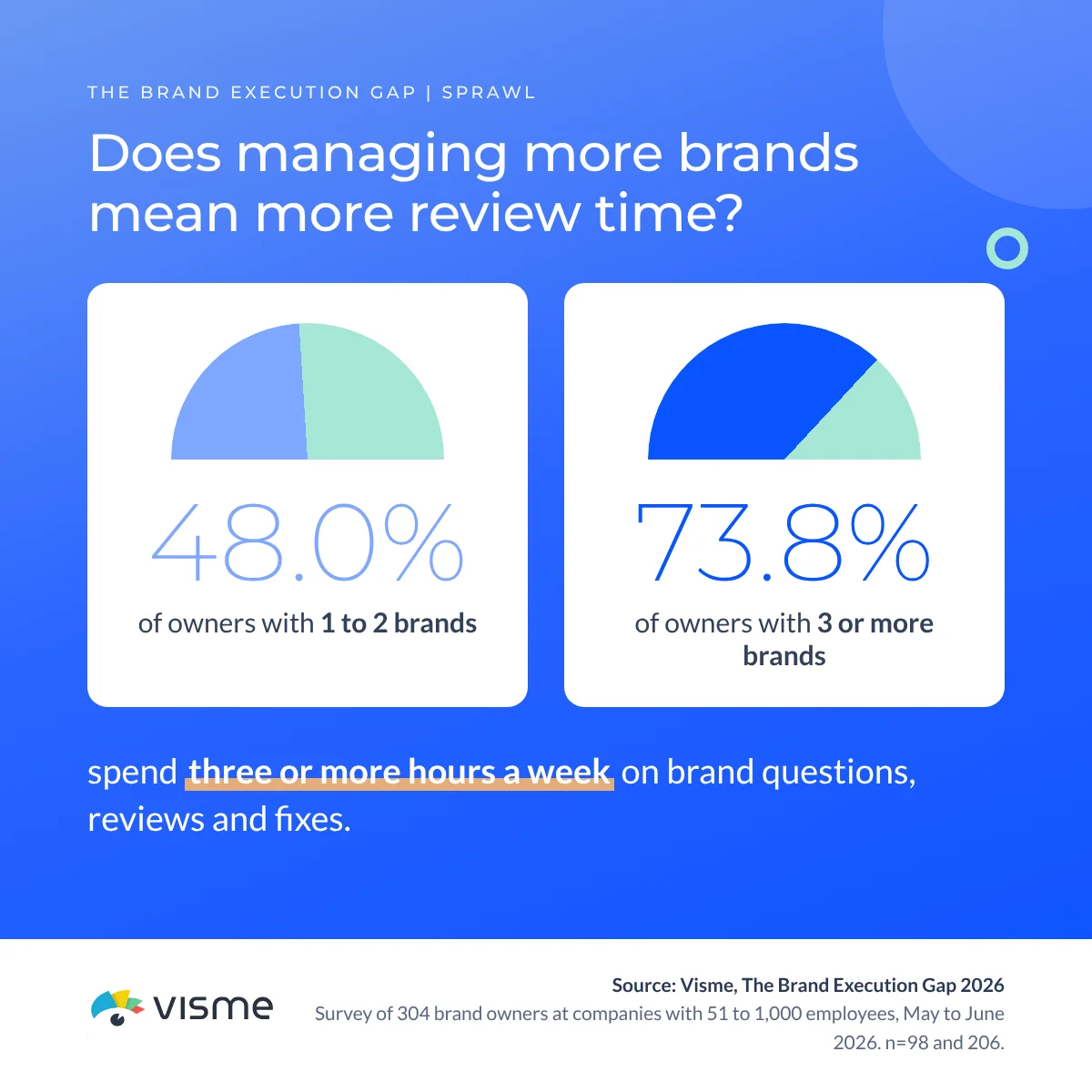
Nearly two-thirds of brand owners, 65.5%, spent at least three hours a week answering brand questions, reviewing work and making fixes. The time rose with the number of brands managed: 48.0% of owners with one or two brands spent three or more hours a week on brand tasks, compared with 73.8% of owners with three or more. Company size didn’t show a reliable difference. And 58.6% fielded brand questions at least daily.
The questions are often practical. Brand owners said colleagues asked them to confirm whether work was on-brand (66.8%), identify which color, font or logo to use (53.6%), and locate an asset (42.4%). These requests connect the review burden to the same issues seen elsewhere: judgment calls, missing specifications and scattered files.
Other research points to a similar time cost in marketing operations. Optimizely reported that three-quarters of marketing leaders spent at least three hours a week editing, fact-checking or correcting AI-generated output. Forrester cited inefficient creation and review processes, along with sales and marketing misalignment, among the leading content operations challenges.
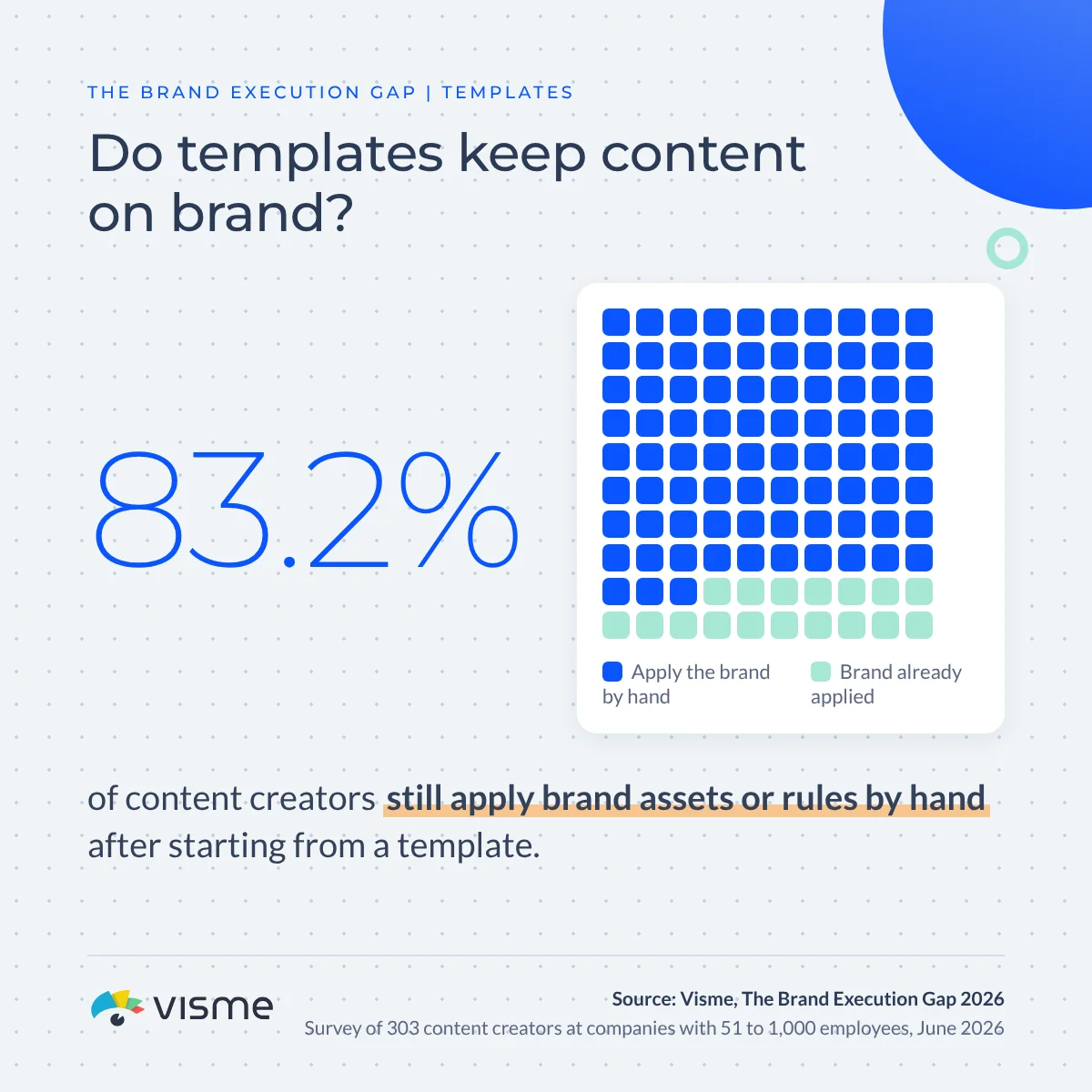
Templates are nearly universal, but seldom remove the work. In the Visme survey, 99.7% of creators used templates. Only 16.8% received templates with the brand already applied, and 83.2% still added brand assets or rules by hand. Among those making brand fixes, 49.2% made small adjustments, 27.1% regularly applied colors and fonts to new elements, and 6.9% restyled most elements. Just 1.3% said a template was usually ready to use as-is.
Creators also described how they got templates: 28.7% copied a colleague’s document, and 26.4% built from scratch in the brand style. Before a template was ready, 60.7% changed text or content, 52.1% replaced images, and 42.9% fixed layout or spacing. Color and font adjustments were needed by 35.3% and 34.0%, respectively.
That’s the point where a template stops acting like a finished system. Long copy, an extra chart column or a custom slide can alter the design decisions that the original layout had settled. If each person fixes the file independently, later teams may copy a modified version as though it were the approved template.
AI raises the stakes for usable brand systems
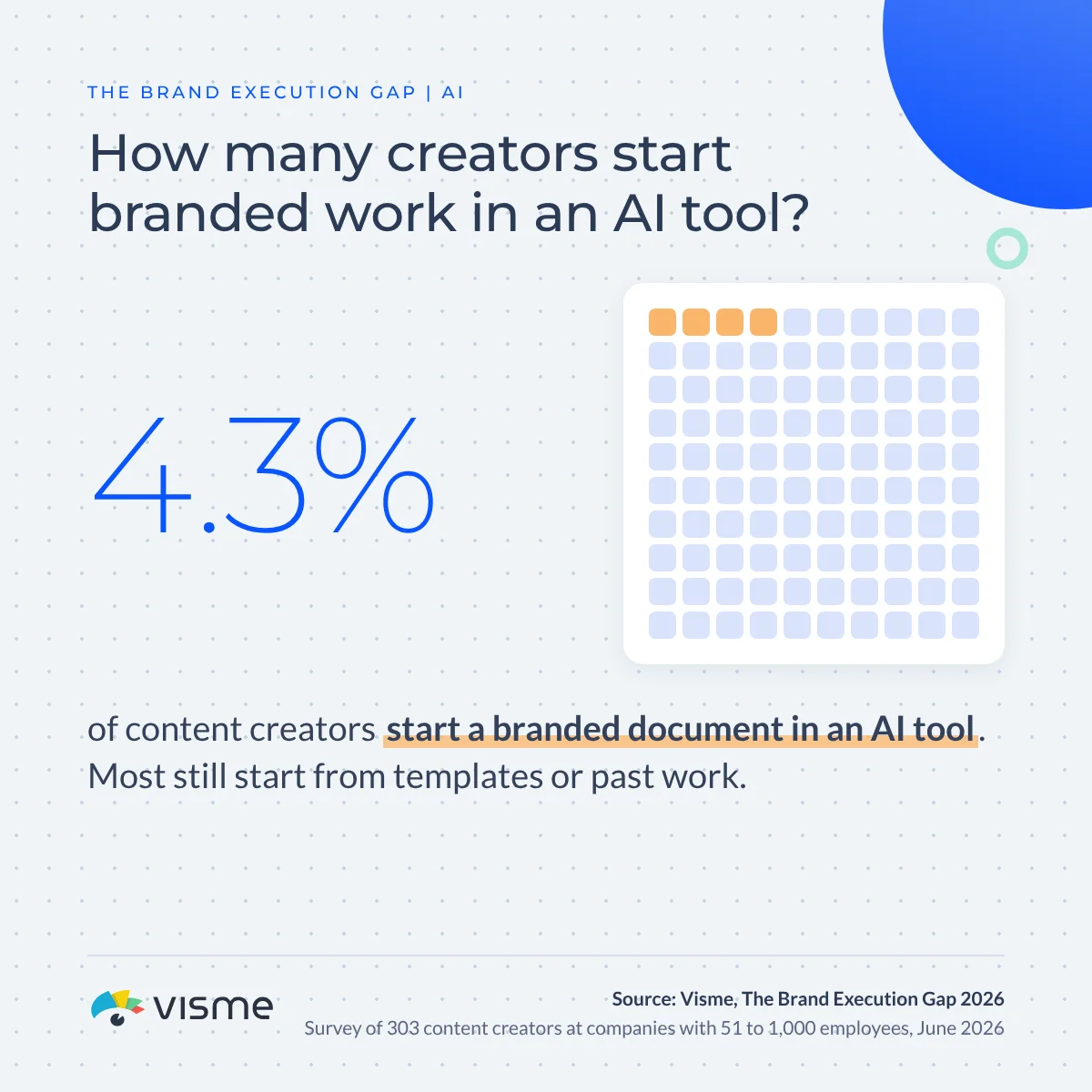
Only 4.3% of surveyed creators started a branded document in an AI tool. The topic appeared without prompting in 17 of 1,461 open-text responses, reflecting both interest and concern. Yet external research suggests the surrounding work is changing: Optimizely found that just 30% of marketing leaders considered their brand voice unmistakable.
In a Gartner survey of 408 senior marketing leaders, 61% said they had adapted content strategies for machine readability and visibility in AI-driven experiences; 42% had taken steps to monitor and correct inaccurate brand information in AI-generated content. Consumer sentiment was mixed: Gartner reported that 50% of US consumers preferred to give business to brands that avoided GenAI in consumer-facing material. In a separate survey, 49% of US consumers said GenAI had reduced the quality of available content, as did 57% of Gen Z and millennial respondents.
Optimizely also found that 25% of marketing leaders frequently or always published AI-generated material they knew wasn’t fully on-brand when under deadline pressure. And Visme’s B2B research reported that 53% of B2B content leaders saw outdated, inaccurate or off-brand material reach customers monthly or more often.
For teams, the design question is where the rules live. A guideline file that’s separate from production tools can be hard to apply consistently, whether a person is working manually or using AI. Brand systems need clear, usable specifications available in the workflow, alongside practical controls for the elements that must stay fixed.
Put brand decisions into the tools and templates
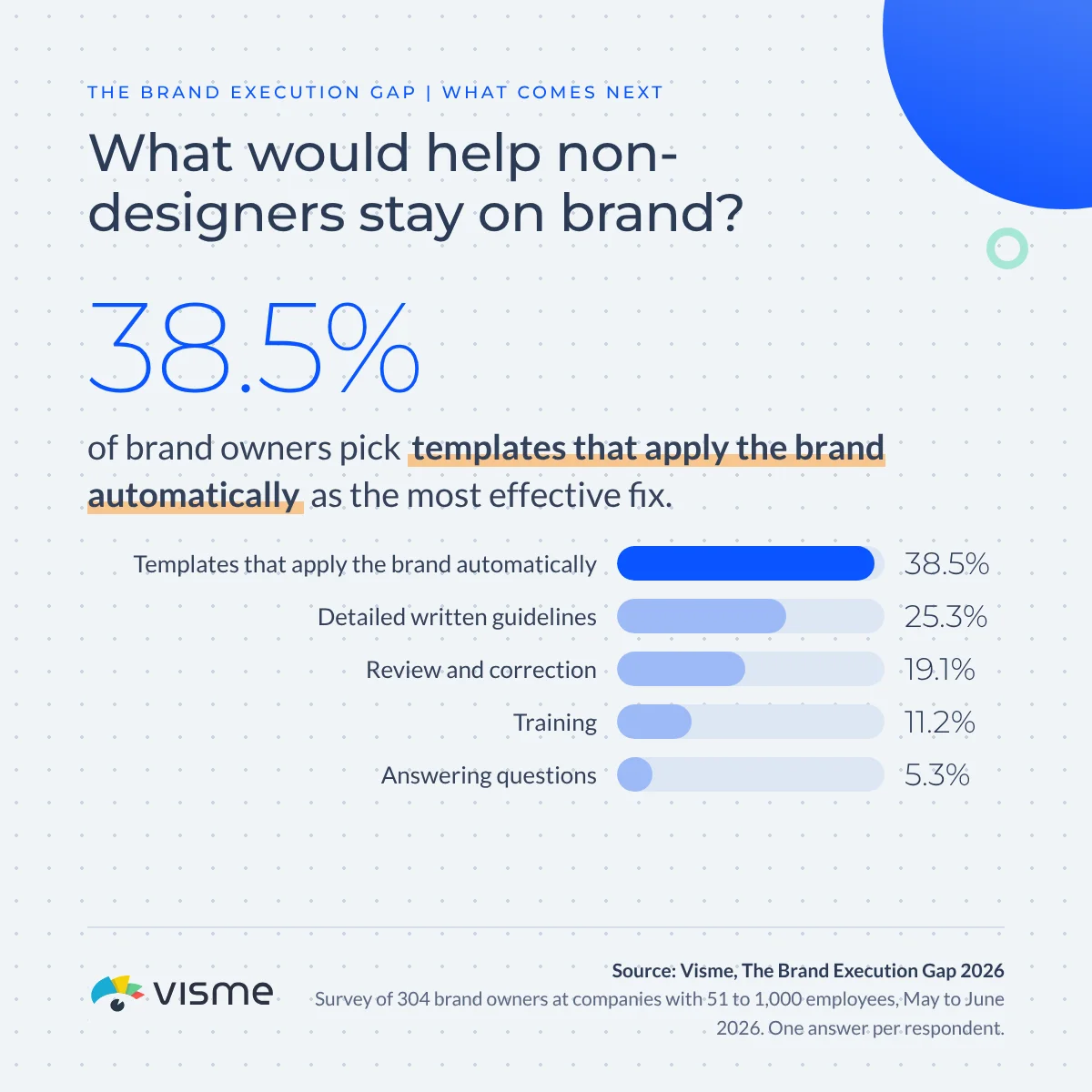
When asked what would best help non-designers, 38.5% of brand owners chose templates that apply the brand automatically. Detailed written guidelines ranked second at 25.3%, followed by review and correction at 19.1%, training at 11.2% and answering questions at 5.3%.
One example comes from LAFC’s 13-person partnership team. The team created a shared slide library and five deck templates with the brand applied in Visme. Representatives assemble presentations from visuals that have already passed design review; decks that once needed three reviewers now need one. Alex Zani of Corporate Partnership Strategy said the library lets the team work from slides whose accuracy has already been checked.
The useful design principle is straightforward: settle repeatable decisions in advance, make approved components easy to find, and give people a reliable way to adapt them. Templates can’t anticipate every change in copy or data, but they can define safe starting points and reduce the number of details each creator must reconstruct.
Visme says its team is testing Visme Playbooks, a new product in beta. The described workflow lets a team upload a deck, lock required content and make presentations from that file. Details are available through the Playbooks waitlist.
Survey details and limits
The Brand Execution Gap 2026 surveyed 607 people at companies with 51 to 1,000 employees in the US, UK, Canada and Australia. The 304 brand owners answered 15 questions from May 28 to June 8, 2026. They were responsible for guidelines, assets, templates or approvals; 7.2% worked in marketing. The 303 content creators answered 20 questions from June 4 to 8, and 12.3% held design titles.
Both surveys used the UserTesting panel and collected 1,461 open-text responses. Each survey’s margin of error was about ±5.6% at the 95% confidence level, so the results are directional; smaller groups have wider margins. Creators were screened as non-users of Visme, which may make the tool-related figures of 16.8% and 18.8% conservative. Quotes are identified by role and country.
For design teams, the clearest next step is to inspect where decisions happen: how people find current assets, what they change in a template, and which questions keep returning to the brand owner. A usable system should make those answers visible at the point of creation.