Monday, November 16, 2026 · Graphic Design
Ten Industrial Designs Make Everyday Objects More Playful and Adaptable
Noted by Mikelle Leow · 672 reads
From a self-centering lamp to a transforming chair, these designs rethink how familiar objects move, store, support and engage.
Industrial design gets interesting when an object asks more of its familiar shape. A lamp can become a small kinetic sculpture; a chair can change configuration by reassigning its own parts. The Good Industrial Design Award from A’ Design Award & Competition brings together realized products and concepts that make these shifts tangible across furniture, toys, lighting and personal objects.
Here, the strongest ideas begin with how something behaves in use. A rocking desk lamp finds its balance again, a stool’s cords hold small keepsakes, and a marble run turns a wave into a new construction problem. Each design makes function part of its visual character.
Movement built into the object
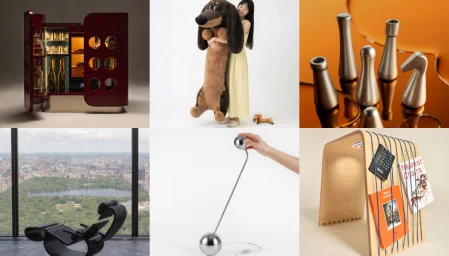
Andrei Ananenka’s Nevi takes the self-righting motion of a roly-poly toy and applies it to a stainless steel desk lamp. Its rounded base and slender stem sway when touched, then return upright. Brushed and mirror-polished finishes make that movement easier to read as reflections shift across the surface.
The lamp directs a focused beam at a 20-degree angle and has a color rendering index above 90. Its packaging extends the same idea of reuse: an aluminum lid contains a CNC-milled outline of the lamp, lit by a wireless 3000K LED module after unboxing. The product and its container share a visual language, while the second light source gives the packaging a continuing role.
Novium’s Hoverpen Interstellar also puts motion on the desk, though its main task is writing. Inspired by spacecraft, the ballpoint pen levitates as a display object and spins when given a twist. Ridges along its body make changes in speed visible; the project description says it can rotate for up to 20 seconds. When the pause is over, it takes replaceable Schmidt ballpoint refills, with access designed to make changing the cartridge straightforward.
For the Silhouette chair, movement changes the furniture’s configuration. Jonah Rappaport’s design converts between armchair, lounge chair and chaise lounge. In the transition from chaise to armchair, the headrest rotates into the rear supports and the legrest becomes the front legs. Concealed locks secure each position without external tools. Adjustable armrests and a continuously adjustable backrest let the sitter make further changes to posture.
Furniture for gathering, sitting and growing
Uslu Design Studio’s The Cuban combines a drinks cabinet with space for DJ equipment. The front presents a bar and display area, while the rear accommodates turntables and music gear. Doors create a gradual reveal of the contents. An integrated humidor stores cigars, with digital controls for humidity and lighting. High-gloss lacquer, stainless steel and marble give the cabinet a substantial presence in a social room, where serving, storage and music share one footprint.
Masuo Fujimura’s Birdcage Chair translates the fine lines of Suruga bamboo filigree, a traditional craft from Japan’s Shizuoka Prefecture, into steel. Slender metal elements form an open frame around the sitter, testing how steel’s strength and flexibility can produce a delicate appearance. Developed with a local metal processing manufacturer, the project also connects the craft reference with Shizuoka’s manufacturing expertise. A mirror-finished seat reflects the space around it, adding a polished surface within the fine framework.
Fabian Haydt’s Stoa chess set draws on Scandinavian design and architectural geometry. Its restrained forms simplify familiar chess pieces while preserving the distinctions players need to recognize during a game. Weighted bases and leather pads help keep the pieces steady, and their shapes are designed for handling. Between matches, the set is intended to sit comfortably in a contemporary interior, so its visual character works both in play and at rest.
The Strings Stool by Yuna Yamashiro draws from the sanshin, a traditional Okinawan stringed instrument. Cords bring the instrument’s tension and rhythm into a seating surface, while also giving users somewhere to tuck small belongings or mementos. Replaceable cords allow color changes; a central opening shapes the seat, and outward-angled trapezoidal legs let the stools stack. The reference informs the stool’s practical details as well as its appearance.
Songmics Home Design Team’s Alan collection is designed for children aged three to seven, with tables, chairs, bookshelves, wall shelves and adjustable coat racks. Adjustable shelf and hanging heights keep belongings within reach as children grow. The table supports changes of activity with double-sided surfaces, magnetic side panels and concealed storage. Solid wood adds a tactile surface, while the collection is intended for smaller homes and kindergartens where furniture may need to serve play, learning and daily routines.
Play that invites experimentation
Hangzhou Yangyang Lejia’s Dirty Dog plush collection turns muddy paws into a cheerful starting point. Its four characters take cues from dogs charging through grass and puddles, with colors drawn from soil, flowers and greenery. The range moves from small companions to larger hugging toys and jumbo body pillows. Scale changes the way each one can be used: carried, leaned against or embraced, including side hugs and fuller wraps.
Sebastian Etter’s Cuboro Wave add-on set brings the rise and fall of gentle waves into the Cuboro marble-run system. Shaped elements send marbles along undulating paths before they continue to another level, adding a new rhythm for builders to plan. Made in Switzerland from Swiss Wood certified beech, the pieces work with existing Cuboro cubes and starter sets. Each run gives players a chance to observe the marble’s route and adjust the track.
Mehmet E. Ergül’s Orpheus is a concept for exercise in space, drawing on exoskeletons, aerial dance and ballet. Intended for the International Space Station and future spacecraft, it brings resistance equipment closer to the astronaut’s body, with compactness a central constraint. Software would record exercise results and adjust resistance, height and body fit to the astronaut and their program. As the user moves, the device supplies resistance. The Orpheus Exoskeletal Exercise Device frames exercise as a question of fitting useful movement into limited room.
Together, these projects show how a familiar product can gain character through the way it moves, adapts or invites handling. Designers and studios can register a project for the competition by February 28, 2027; winners will be announced May 1, 2027.