Wednesday, October 21, 2026 · UX & UI Design
How teamLab Builds Immersive Art Around Living Flowers, Air and Movement
Noted by Tim Thompson · 338 reads
At OFFF Barcelona 2026, teamLab’s Saka Naka explains how a specialist collective makes artworks that respond to people and place.
teamLab’s most distinctive design choice may be to treat the room itself as part of the artwork. Orchids rise around a visitor who stands still; projected butterflies cross between rooms; spheres hold their shape through moving air. At OFFF Barcelona 2026, Sakurako “Saka” Naka described how the Tokyo collective builds these experiences—and how its working structure keeps experiments connected to the finished space.
Tim Thompson of RevThink spoke with Naka at Disseny Hub Barcelona on April 18, 2026, the morning after her main-stage talk. The conversation ranged from teamLab’s business model to its ideas about perception. Across both, a consistent principle emerged: the work depends on relationships among people, materials and environments, rather than on an isolated image or object.
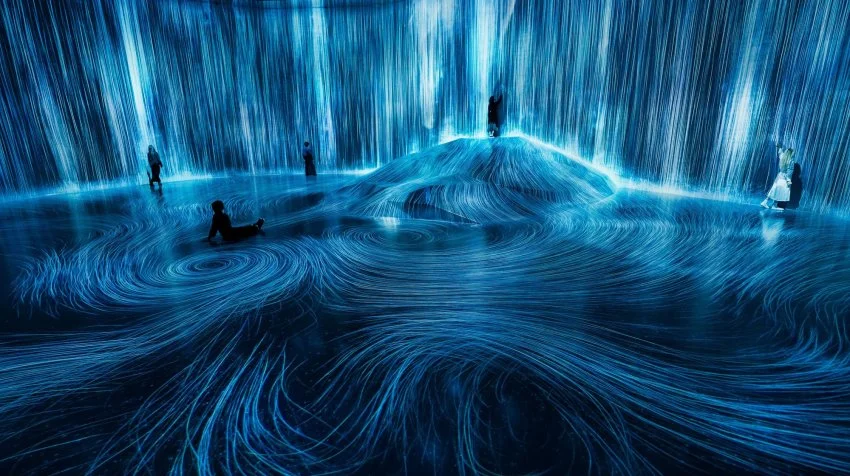
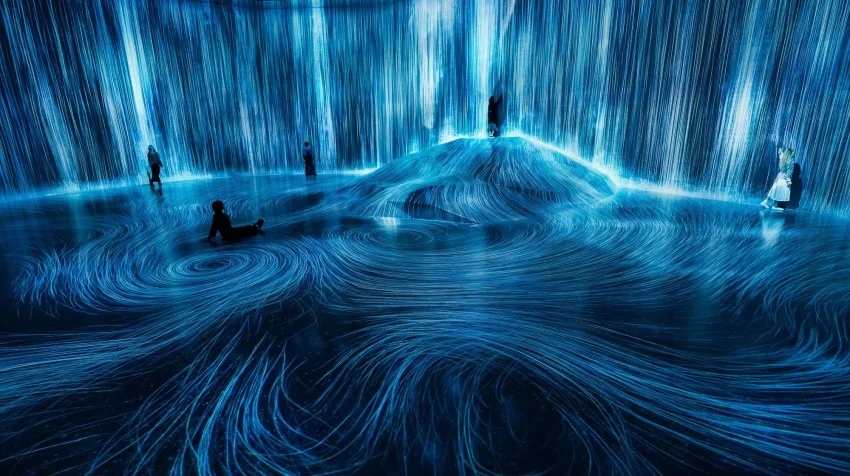
teamLab, Universe of Water Particles on a Rock where People Gather. teamLab Borderless, Tokyo. © teamLab
A working structure built around making
About 25 years ago, five friends left graduate school and began making work together. Toshiyuki Inoko, known within the group as Toshi, wanted to make art. The five supported that ambition by building technology for companies during the day and putting the resulting income toward their artworks. Naka described this as the way they sustained themselves.
That arrangement developed into two connected areas of work. The digital solutions team now builds apps and systems for postal services, banks and airlines, including work at a nationwide scale in Japan. The art collective develops installations and exhibitions. Three of the four friends who started alongside Toshi are still involved; they run the digital solutions work so he can concentrate on making art.
The name teamLab describes the intended structure: “a laboratory for a team.” Naka said the group has no internal titles. It brings together specialists in art, mathematics, software and hardware engineering, architecture and botanical work. Rather than assigning projects to fixed departments, the team gathers around an artwork and brings in the knowledge that its development calls for.
An idea may begin with Toshi, then draw in different people as the group tests what it can become. Some lines of inquiry have continued for more than 15 years. One recurring question is how light might become a three-dimensional sculpture in space. For each exhibition, the team considers what it wants to investigate and share at that moment.
Exhibitions also call for people who can connect the work across a building. Naka calls them “catalysts”: members who know which engineers and architects are involved in different artworks and bring them together around the larger space. She described “catalyst” as more of a description than a formal position. Everyone works full time, and the boundaries between the art and digital solutions groups are permeable. When an artwork needs an insight from the technology side, people can find one another and work it through.
“We don’t have titles within teamLab.”
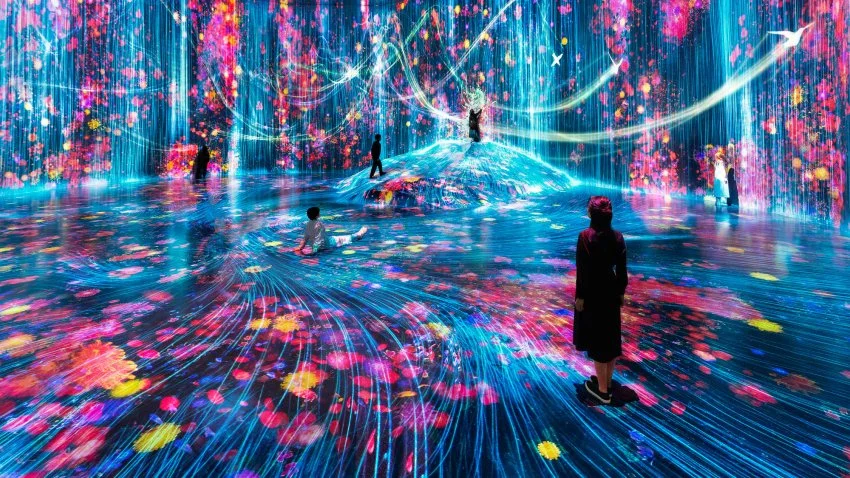
teamLab Borderless, MORI Building Digital Art Museum, Azabudai Hills, Tokyo. © teamLab
Prototyping with the room and the material
teamLab develops projects in stages, starting with small experiments in its Tokyo studio, scaling them up in large warehouses outside the city, then completing the work on site. The final installation can take weeks of adjustment as the team works through corners, angles and other conditions of the actual space. Naka emphasized that some discoveries only happen through physical making. A plan or digital test cannot fully predict what an artwork will do in a particular room.
That on-site learning becomes shared knowledge for later projects. Naka compared the process to the craft of shaping timber for traditional Japanese temples. The people working directly with each beam could influence the larger structure because every piece of wood was different. She said the separation between making and design came later, describing it as a change in practice rather than a matter of one approach being better.
The team’s Tokyo studio supports quick exchanges. One floor is open, with tables and few walls; two glass rooms allow calls with people overseas. Since members work across several projects, questions about a space can reach someone with relevant experience nearby. The physical layout makes it easy to bring practical knowledge into a discussion while the work is still taking shape.
This way of working suits installations whose behavior depends on many interacting parts. Naka mentioned teamLab works featuring schools of fish or birds and acknowledged that the group does not fully understand every kind of communication or movement it observes. That uncertainty is part of the inquiry: the team makes room for patterns that can be experienced before they can be completely explained.
When the flowers respond to a visitor
Naka showed Thompson Floating Flower Garden: Flowers and I are of the Same Root, the Garden and I are One, an interactive installation that began in 2015. More than 13,000 living orchids hang in a Tokyo room without soil. Naka explained that many orchids can take in water from the air. The flowers are suspended low enough to meet visitors at close range.
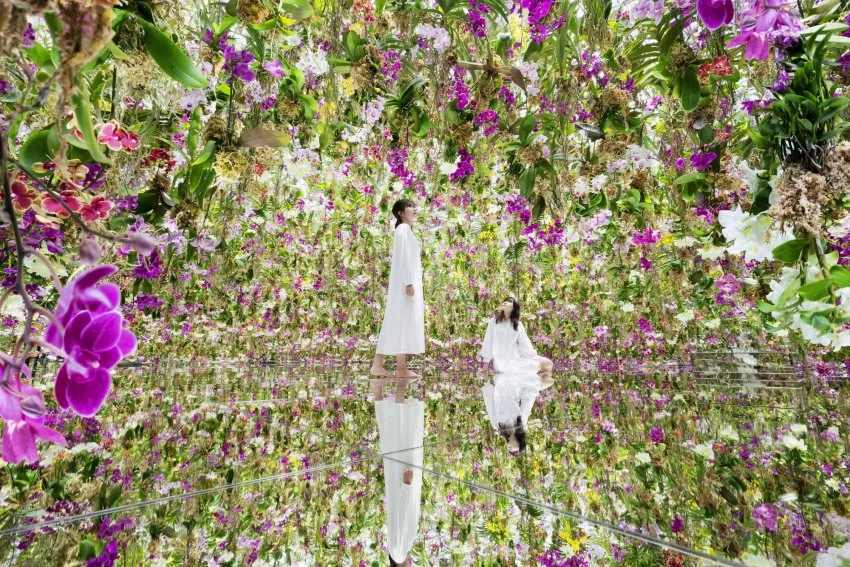
teamLab, Floating Flower Garden: Flowers and I are of the Same Root, the Garden and I are One, 2015-, interactive installation. © teamLab
The installation changes in response to a person’s movement. When someone enters and stands still, nearby flowers begin to float upward, opening a space around the body. Move slowly and that opening travels with you. When another visitor approaches from the opposite side, the two spaces can merge. The visitor does not just look at a botanical display; their position helps shape how it unfolds.
Naka connected the work to a Zen saying about looking at a flower as though looking at a dream. People may understand intellectually that they are connected to nature, she said, yet find that connection hard to feel. The installation gives that idea a physical form: spend time among the orchids, and their movement can make the visitor feel noticed in return.
“If you stand for a while, the flowers almost look back at you.”
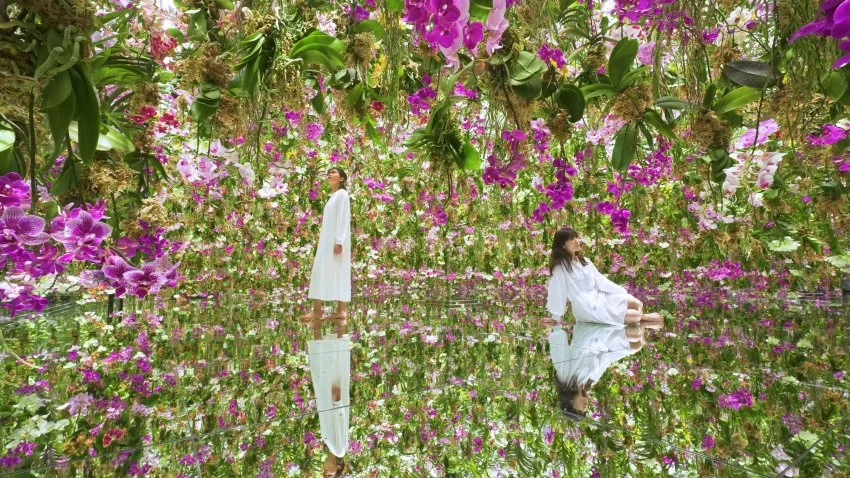
teamLab, Floating Flower Garden. More than 13,000 living orchids, rooted in air. © teamLab
Making sculpture from environmental forces
Naka also described a distinction between objects and phenomena. A whirlpool, she explained, is made of water that is continuous with the surrounding water. What gives it form is the movement of energy through it. Try to scoop it up and put it in a container, and the whirlpool disappears. The example offers a useful lens for teamLab’s installations: some forms exist through ongoing conditions, not as things that can be separated from their setting.
That thinking informs the Environmental Phenomena series and teamLab Phenomena Abu Dhabi. The installation includes sculptures generated by environmental forces. In Morphing Continuum, a column of spheres rises about five metres, held in position by airflow. From across the room, it reads as a solid vertical form; visitors can walk into it while it continues to exist.

teamLab, Light Vortex. teamLab Phenomena Abu Dhabi. © teamLab
The work makes the surroundings part of its construction. As Naka put it, the sculptures are inseparable from their environment: while the conditions remain, the forms can keep appearing. TeamLab decided what went into the Abu Dhabi venue. The project was developed with the Department of Culture and Tourism Abu Dhabi and Miral.
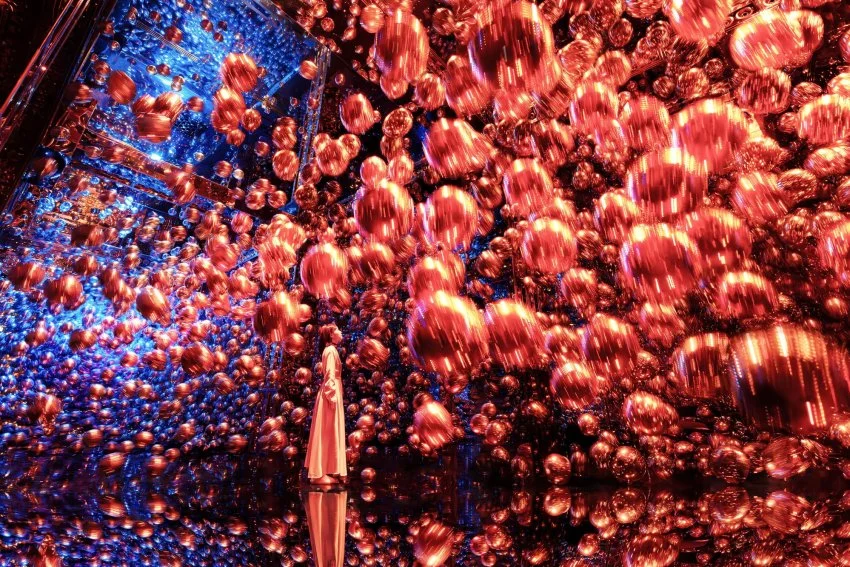
teamLab, Morphing Continuum. A sculpture of spheres held in place by the flow of air alone. teamLab Phenomena Abu Dhabi. © teamLab
Borderless as a changing system
teamLab Borderless moved to a new Tokyo space in 2024, and the collective’s next museum is planned for Hamburg. The Tokyo museum offers no map or prescribed route. Visitors move between rooms and choose how long to stay, while artworks can travel through corridors, change form and overlap with other pieces.
The work also responds to who is present. In Flutter of Butterflies Beyond Borders, butterflies emerge through people’s presence; before visitors arrive, there are none. Touch one and it dies. This interaction makes behavior part of the experience, and it ties each visitor’s encounter to what other people in the museum are doing.
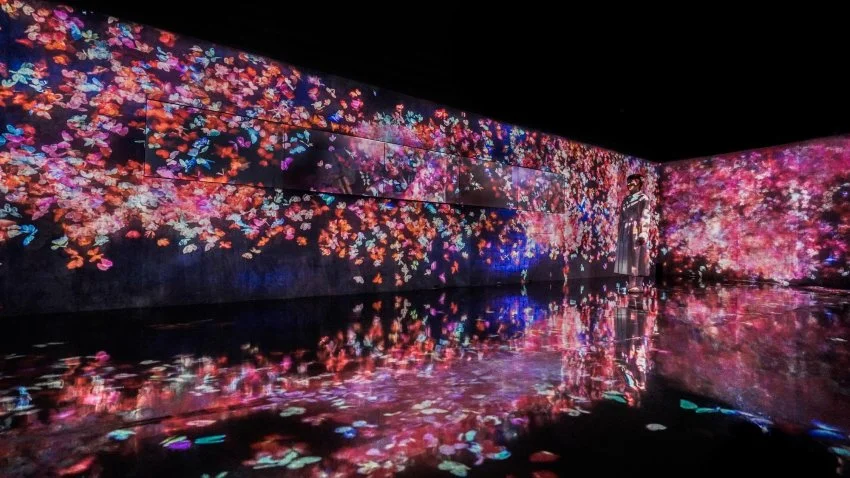
teamLab, Flutter of Butterflies Beyond Borders. teamLab Borderless, Tokyo. © teamLab
Naka’s account of beauty follows from this structure. A single flower or ring can be treated as a beautiful object because it is distinct from its surroundings. In Borderless, the visitor encounters a world that keeps changing through their own actions and those of strangers nearby. The focus can shift from an individual image to the continuity connecting the images, the rooms and the people moving through them.
“The fact that the world is continuous, and that we live in this continuity, that’s the object of beauty.”
Images that leave room for the body
The final work Thompson saw was a wall of blooming flowers. Naka used it to discuss how camera-based images fix a viewer’s position. A fixed viewpoint can make the body feel unnecessary to looking, she said, while also making a certain kind of objectivity possible. TeamLab has spent years testing how a scene can be flattened into two dimensions while still feeling as though it shares the viewer’s space.

teamLab, People Don’t See the World as through a Camera. The letters at the entrance of teamLab Borderless only rise toward you through a lens. © teamLab
The collective calls its approach Ultrasubjective Space. Rather than anchoring an image to a single viewpoint, it builds a scene so visitors cannot easily tell whether the flowers appear on their side of a wall or beyond it. People tend to drift toward the image, responding to it as a presence within the room.
Naka pointed to pre-modern East Asian scrolls and folding screens, which were not built around Western linear perspective. Her point was that people have ways of seeing the world beyond the camera’s fixed view. When Thompson asked whether the approach was a technical or creative achievement, she answered that sometimes the thing a team wants to make does not yet exist, so the team has to invent its form.
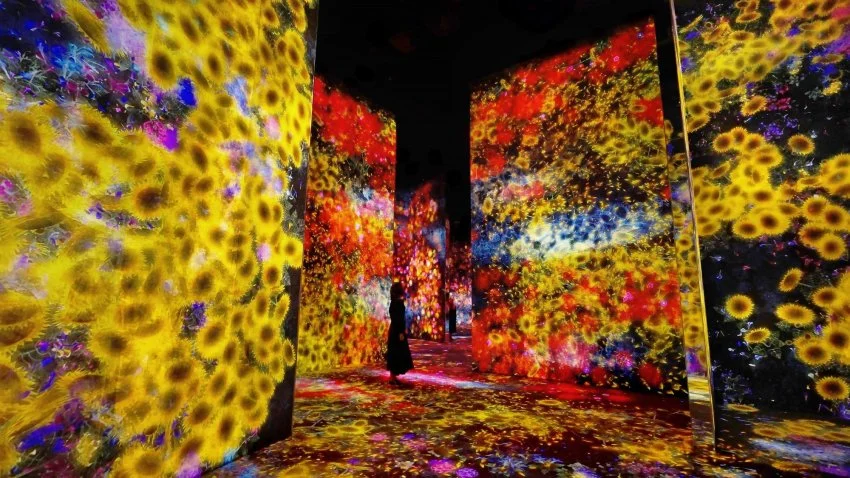
teamLab, Flowers and People, Cannot be Controlled but Live Together. teamLab Borderless, Tokyo. © teamLab
A practice sustained one day at a time
TeamLab’s commercial work supports the conditions for its art practice. The group began by earning income through technology projects while developing artworks, and that structure still connects its two areas of work. Naka’s description suggests that the business model is part of the creative method: it gives the collective a way to keep making without requiring each artwork to justify itself as a conventional product.
Asked about plans five or ten years ahead, Naka said Toshi’s response is consistent: make something today, then continue tomorrow. For a practice built on repeated experiments, shared skills and works that depend on their surroundings, that answer feels less like a slogan than a working method. Start with what the team can make now, learn from the space and the people in it, then carry that knowledge into the next piece.
Interview and words: Tim Thompson, RevThink, recorded at OFFF Barcelona 2026
Featured guest: Sakurako “Saka” Naka, teamLab, Tokyo (teamLab does not use titles, and neither does she)
Recorded: April 18, 2026, Disseny Hub Barcelona
Website: teamlab.art
Instagram: @teamlab
Series: OFFF Barcelona 2026 conversations, part two of four